

Peninsular Rivers
The Indian drainage system is broadly divided into the geologically young, snow-fed Himalayan rivers and the older, rain-fed Peninsular rivers. The Peninsular rivers flow through broad, shallow valleys, having reached their base level of erosion over millions of years. As agricultural and industrial demands intensify, these river basins have become the focal points of massive infrastructural development and complex geopolitical disputes.
This comprehensive farticle details each major peninsular river system individually, outlining their geographical courses, infrastructural developments, and associated legal conflicts.
East-Flowing Peninsular Rivers
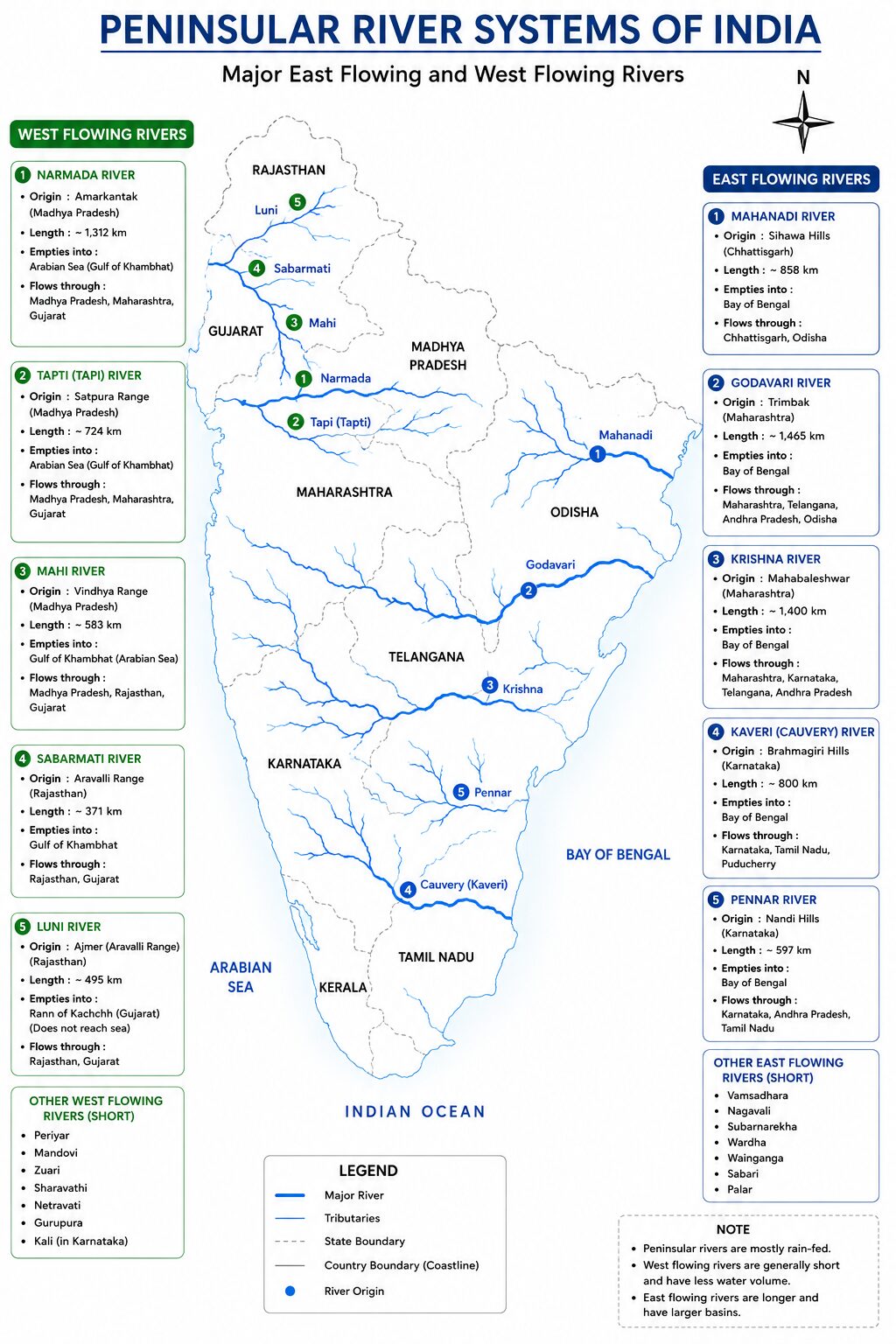
The natural topographic tilt of the Deccan Plateau is from west to east, directing the majority of the Peninsular drainage into the Bay of Bengal, where they form extensive deltas.
1. The Godavari River System
The Godavari, often referred to as the Dakshin Ganga (Ganges of the South), is the largest and longest river system in Peninsular India.
- Origin and Course: It originates at Trimbakeshwar in the Nashik district of Maharashtra, situated in the Western Ghats. It traverses across Maharashtra, Telangana, and Andhra Pradesh, before emptying into the Bay of Bengal.
- Major Tributaries:
- Left Bank: Penganga, Wardha, and Wainganga (which merge to form the Pranhita), Indravati, Sabari.
- Right Bank: Manjira, Pravara.
- Hydroelectric Projects: The basin hosts several power stations, including the Upper Indravati and Sriram Sagar hydroelectric plants.
- Irrigation Projects: The Kaleshwaram Lift Irrigation Project (KLIP) in Telangana stands as the world’s largest multi-stage lift irrigation initiative. Additionally, the Polavaram National Project in Andhra Pradesh remains a critical multi-purpose irrigation endeavor.
Major Dams on the Godavari and Tributaries
| Dam Name | River | State | Primary Purpose |
| Jayakwadi Dam | Godavari | Maharashtra | Irrigation, Drinking Water |
| Sriram Sagar Project | Godavari | Telangana | Irrigation, Hydroelectric |
| Polavaram Dam (Under Construction) | Godavari | Andhra Pradesh | Multi-purpose, Interlinking |
| Upper Indravati Dam | Indravati | Odisha | Hydroelectric |
2. The Krishna River System
The Krishna basin constitutes a vital agricultural lifeline for the semi-arid regions of the Deccan Plateau.
- Origin and Course: It originates near Mahabaleshwar in the Western Ghats (Maharashtra). It flows eastwards through Maharashtra, Karnataka, Telangana, and Andhra Pradesh.
- Major Tributaries:
- Left Bank: Bhima, Musi, Munneru.
- Right Bank: Tungabhadra, Ghataprabha, Malaprabha, Koyna.
- Hydroelectric Projects: The Srisailam and Nagarjuna Sagar dams are massive power generation hubs situated in the deep gorges of the Nallamala Hills. The Koyna Hydroelectric Project in Maharashtra is one of the largest completed power stations in India.
- Irrigation Projects: The Upper Krishna Project, centered around the Almatti Dam, provides extensive irrigation to drought-prone districts in Northern Karnataka.
Major Dams on the Krishna and Tributaries
| Dam Name | River | State | Primary Purpose |
| Almatti Dam | Krishna | Karnataka | Irrigation, Hydroelectric |
| Nagarjuna Sagar Dam | Krishna | Telangana / AP | Multi-purpose |
| Srisailam Dam | Krishna | Telangana / AP | Hydroelectric |
| Tungabhadra Dam | Tungabhadra | Karnataka | Multi-purpose |
| Koyna Dam | Koyna | Maharashtra | Hydroelectric |
3. The Kaveri (Cauvery) River System
The Kaveri is unique among Peninsular rivers because it receives rainfall from both the South-West monsoon (in its upper catchment) and the North-East monsoon (in its lower catchment), resulting in a comparatively perennial flow.
- Origin and Course: It originates at Talakaveri in the Brahmagiri hills of Kodagu (Coorg), Karnataka, and flows southeast through Karnataka and Tamil Nadu.
- Major Tributaries: Kabini, Hemavati, Bhavani, Amaravati, Arkavathi.
- Hydroelectric Projects: The Shivanasamudra Falls host one of the oldest hydroelectric power stations in Asia (established in 1902).
- Irrigation Projects: The basin is intensely utilized for paddy cultivation, supported heavily by the Krishna Raja Sagara (KRS) and Mettur reservoirs.
Major Dams on the Kaveri and Tributaries
| Dam Name | River | State | Primary Purpose |
| Krishna Raja Sagara (KRS) | Kaveri | Karnataka | Irrigation, Drinking Water |
| Mettur Dam | Kaveri | Tamil Nadu | Irrigation, Hydroelectric |
| Kabini Dam | Kabini | Karnataka | Irrigation |
| Bhavanisagar Dam | Bhavani | Tamil Nadu | Irrigation |
4. The Mahanadi River System
The Mahanadi basin encompasses significant portions of Chhattisgarh and Odisha, serving as a crucial water source for agriculture and heavy industries.
- Origin and Course: It originates near Sihawa in the Raipur district of Chhattisgarh and flows through Odisha to form a large delta in the Bay of Bengal.
- Major Tributaries: Seonath, Hasdeo, Mand, Ib, Ong, Tel, Jonk.
- Hydroelectric and Irrigation Projects: The Hirakud Dam fundamentally transformed the economy of Odisha by mitigating catastrophic coastal floods and generating substantial hydroelectric power.
Major Dams on the Mahanadi and Tributaries
| Dam Name | River | State | Primary Purpose |
| Hirakud Dam | Mahanadi | Odisha | Flood Control, Hydroelectric |
| Gangrel Dam (Ravishankar Sagar) | Mahanadi | Chhattisgarh | Irrigation |
| Hasdeo Bango Dam | Hasdeo | Chhattisgarh | Hydroelectric, Irrigation |
West-Flowing Peninsular Rivers
Due to steep gradients and rocky topography along the western escarpment of the plateau, west-flowing rivers form estuaries rather than deltas before emptying into the Arabian Sea.
1. The Narmada River
The Narmada is the largest west-flowing river, known for traversing a prominent geological rift valley.
- Origin and Course: It originates at the Amarkantak Plateau in Madhya Pradesh. It flows westwards through a rift valley situated between the Vindhya Range (north) and the Satpura Range (south), crossing Madhya Pradesh, Maharashtra, and Gujarat.
- Major Tributaries: Hiran, Tawa, Banjar, Shar.
- Hydroelectric and Irrigation Projects: The Narmada Valley Project comprises a series of large dams. The Sardar Sarovar Dam provides critical drinking water and irrigation to the arid regions of Saurashtra and Kutch.
Major Dams on the Narmada
| Dam Name | River | State | Primary Purpose |
| Sardar Sarovar Dam | Narmada | Gujarat | Multi-purpose |
| Indira Sagar Dam | Narmada | Madhya Pradesh | Multi-purpose |
| Omkareshwar Dam | Narmada | Madhya Pradesh | Hydroelectric |
2. The Tapi (Tapti) River
- Origin and Course: It originates in the Betul district of Madhya Pradesh in the Satpura range and flows through a rift valley parallel to the Narmada.
- Major Tributaries: Purna, Girna, Panjhra.
- Hydroelectric and Irrigation Projects: The river supports significant agricultural belts in Gujarat and Maharashtra.
Major Dams on the Tapi
| Dam Name | River | State | Primary Purpose |
| Ukai Dam | Tapi | Gujarat | Multi-purpose |
| Kakrapar Weir | Tapi | Gujarat | Irrigation |
The Indus River System (Revision)
While geographically a Himalayan system, the Indus Basin demands intense scrutiny due to accelerated infrastructural development and severe geopolitical ramifications.
- Origin: Tibetan Plateau near Lake Mansarovar.
- Major Tributaries: Jhelum, Chenab, Ravi, Beas, Sutlej.
- Current Geopolitical Context (2025-2026): Following the April 2025 Pahalgam terror attack, India placed the 1960 Indus Waters Treaty (IWT) in “abeyance.” Consequently, routine data sharing with Pakistan has been suspended. Furthermore, India has completed the Shahpur Kandi Barrage (early 2026), decisively stopping unutilized surplus water from the Ravi river (an Eastern river allocated entirely to India) from flowing into Pakistan. India is also aggressively advancing a cascade of run-of-the-river hydroelectric projects on the Chenab river.
Major Strategic Dams on the Indus System (India)
| Dam Name | River | State/UT | Strategic Significance |
| Bhakra Nangal Dam | Sutlej | HP / Punjab | Largest capacity, Green Revolution anchor |
| Shahpur Kandi Barrage | Ravi | Punjab / J&K | Halts surplus water flow to Pakistan (2026) |
| Ratle Hydroelectric Project | Chenab | J&K | High-capacity RoR project (Under Construction) |
| Kishanganga Dam | Jhelum (Trib.) | J&K | Successful diversion despite international arbitration |
| Salal Dam | Chenab | J&K | Major operational RoR project |
River Interlinking Projects in India
The National Perspective Plan (NPP) for river interlinking aims to mitigate regional droughts and floods by transferring water from surplus basins to deficit basins.
- Ken-Betwa Link Project: The first operationalized project under the NPP. It transfers water from the Ken River (surplus) to the Betwa River to irrigate the parched Bundelkhand region spanning Madhya Pradesh and Uttar Pradesh. A significant environmental concern is the submergence of core areas within the Panna Tiger Reserve.
- Godavari-Krishna Link: Achieved practically by the Andhra Pradesh government through the Pattiseema Lift Irrigation Project, which transfers surplus Godavari water to the Krishna basin to stabilize the Krishna delta region.
- Godavari-Cauvery Link (Proposed): A macro-level proposal to divert unutilized floodwaters from the Godavari downstream into the Krishna, Pennar, and eventually the Cauvery basin, addressing the chronic, structural water deficits of Tamil Nadu.
Interstate Water Disputes in Peninsular India
Under Article 262 of the Constitution, the Parliament is empowered to adjudicate interstate river disputes. Due to the seasonal nature of Peninsular rivers, agricultural demands regularly trigger severe legal conflicts.
- The Cauvery Water Dispute (Karnataka, Tamil Nadu, Kerala, Puducherry):The most prominent water conflict in South India. Karnataka, the upper riparian state, asserts the right to utilize river waters for its expanding agricultural and urban needs (e.g., Bengaluru). Tamil Nadu, the lower riparian state, relies heavily on historical flows to sustain its expansive paddy cultivation. The Supreme Court finalized the allocation in 2018 and mandated the creation of the Cauvery Water Management Authority (CWMA).
- The Krishna Water Dispute (Maharashtra, Karnataka, Telangana, Andhra Pradesh):Initially adjudicated by the Krishna Water Disputes Tribunal (KWDT), the conflict resurged following the bifurcation of Andhra Pradesh in 2014. Telangana has demanded a fresh tribunal to formally establish its distinct state quota, independent of Andhra Pradesh’s historical share.
- The Mahadayi (Mandovi) Dispute (Goa, Karnataka, Maharashtra):Karnataka intends to divert water from the Mahadayi basin to the Malaprabha basin (via the Kalasa-Banduri Nala project) to address drinking water scarcity in northern districts. Goa fiercely opposes this diversion, arguing it will permanently disrupt the fragile ecology of its estuarine zones and coastal fisheries.
Read Here: River Systems of India
Read Full Article Here: Ganga River System
Indus River Complete Details Here: Indus River System
Complete Your Revision: Brahmaputra River System
