

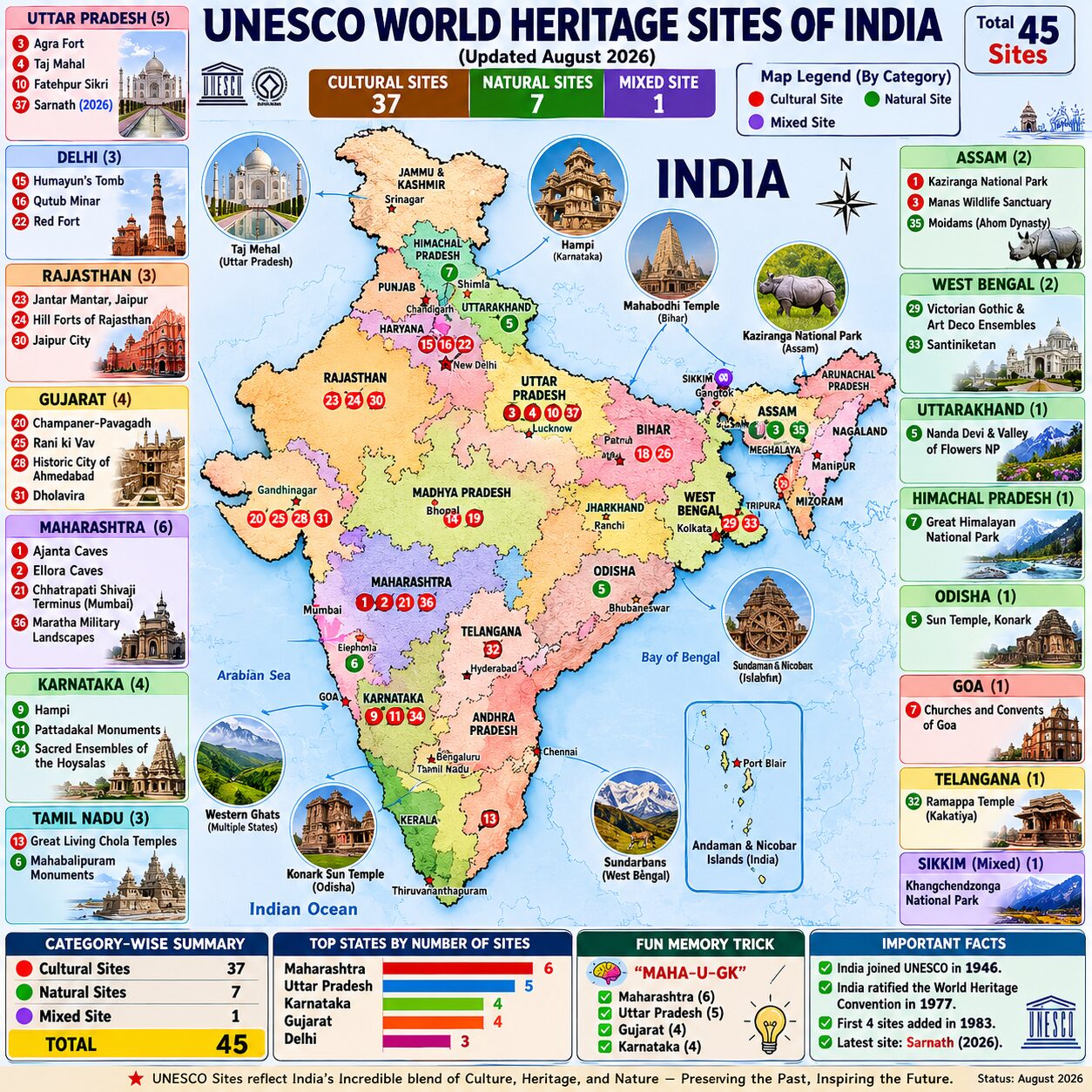
UNESCO World Heritage Sites of India (Updated August 2026)
Why in News?
India added another feather to its cultural crown after Sarnath, the sacred Buddhist site where Lord Buddha delivered his first sermon, was inscribed on the UNESCO World Heritage List during the 48th Session of the UNESCO World Heritage Committee held in Busan, South Korea, on 25 July 2026. With this achievement, India now has 45 UNESCO World Heritage Sites, reinforcing its position among the countries possessing the richest cultural and natural heritage in the world.
The inclusion of Sarnath is significant because it recognises not only India’s ancient Buddhist legacy but also its continued commitment to preserving globally important monuments, archaeological sites, ecosystems, and living cultural traditions. For UPSC, UPPSC and other State PCS examinations, UNESCO World Heritage Sites remain one of the most frequently asked topics in both Prelims and Mains.
UNESCO World Heritage Sites of India
India is often described as a living museum. Every region reflects centuries of civilisation through magnificent temples, forts, caves, cities, forests, mountains, rivers, and archaeological remains. Many of these places possess exceptional cultural or natural importance that extends beyond national boundaries. Recognising their universal significance, UNESCO grants them the status of World Heritage Sites, ensuring that they receive international recognition and protection.
The United Nations Educational, Scientific and Cultural Organization (UNESCO) is a specialised agency of the United Nations established on 16 November 1945, immediately after the Second World War. The organisation aims to build peace through cooperation in education, science, culture, communication and information. Its headquarters are located in Paris, France.
Among UNESCO’s numerous programmes, the World Heritage Programme is considered one of the most prestigious. The programme identifies, protects and conserves places that possess Outstanding Universal Value (OUV) for humanity.
What is a UNESCO World Heritage Site?
A UNESCO World Heritage Site is a place recognised as having exceptional cultural or natural importance for all humankind. Although these sites lie within the sovereign territory of individual countries, their preservation becomes the collective responsibility of the international community.
A World Heritage Site may include:
- Ancient monuments
- Historic cities
- Archaeological remains
- Religious structures
- Cultural landscapes
- National parks
- Wildlife habitats
- Geological formations
- Forest ecosystems
- Mountain ranges
UNESCO recognition enhances international visibility, promotes tourism, attracts funding for conservation and encourages scientific research. However, inscription also places a greater responsibility on governments to protect these sites for future generations.
UNESCO World Heritage Convention, 1972
The idea of protecting heritage through international cooperation emerged after successful global efforts to save the Abu Simbel Temples in Egypt during the construction of the Aswan High Dam in the 1960s. Inspired by this collaboration, UNESCO adopted the Convention Concerning the Protection of the World Cultural and Natural Heritage on 16 November 1972.
The Convention came into force in 1975 and has now become one of the world’s most successful international heritage agreements.
India ratified the Convention in 1977, making it eligible to nominate sites for inclusion on the World Heritage List.
The Convention seeks to:
- Protect heritage of outstanding universal value.
- Promote international cooperation.
- Strengthen conservation efforts.
- Encourage sustainable tourism.
- Provide technical and financial assistance.
- Raise awareness about heritage preservation.
Today, more than 190 countries are State Parties to the Convention.
What is Outstanding Universal Value (OUV)?
Every World Heritage Site must possess Outstanding Universal Value (OUV).
Outstanding Universal Value means that a property has such exceptional cultural or natural significance that it transcends national boundaries and is important for present as well as future generations of all humanity.
This principle distinguishes ordinary heritage sites from UNESCO World Heritage Sites.
For example:
- The Taj Mahal represents one of the finest masterpieces of Mughal architecture.
- Kaziranga National Park protects globally significant populations of the one-horned rhinoceros.
- Sarnath symbolises the birthplace of Buddhist teachings that influenced millions across Asia.
Only sites possessing such extraordinary value qualify for inscription.
Categories of UNESCO World Heritage Sites
UNESCO classifies World Heritage properties into three categories.
| Category | Meaning | India’s Total (August 2026) |
|---|---|---|
| Cultural | Monuments, archaeological sites, temples, forts, cities, cultural landscapes | 37 |
| Natural | National parks, wildlife sanctuaries, forests, mountains and ecosystems | 7 |
| Mixed | Sites possessing both cultural and natural significance | 1 |
India’s heritage portfolio reflects remarkable diversity. From Himalayan landscapes to Buddhist monasteries, from Mughal architecture to Harappan cities, the country represents nearly every phase of human civilisation.
UNESCO Selection Criteria
UNESCO follows ten selection criteria. A property must satisfy at least one criterion to qualify for inscription.
| Criterion | Description | Indian Example |
|---|---|---|
| (i) | Masterpiece of human creative genius | Taj Mahal |
| (ii) | Exchange of human values in architecture, planning or technology | Jaipur City |
| (iii) | Exceptional testimony to a civilisation or cultural tradition | Nalanda Mahavihara |
| (iv) | Outstanding architectural or technological ensemble | Agra Fort |
| (v) | Traditional human settlement or land-use | Sacred Ensembles of the Hoysalas |
| (vi) | Direct association with events, beliefs or traditions | Sarnath |
| (vii) | Exceptional natural beauty | Valley of Flowers National Park |
| (viii) | Outstanding geological processes | Western Ghats |
| (ix) | Significant ecological processes | Great Himalayan National Park |
| (x) | Important biodiversity habitat | Kaziranga National Park |
Unlike a common misconception, a site does not need to satisfy all ten criteria. Meeting even one criterion is sufficient if UNESCO experts conclude that the property possesses Outstanding Universal Value.
How Does a Site Become a UNESCO World Heritage Site?
The inscription process is scientific, transparent and often takes several years.
The first step is the preparation of the Tentative List. Every country prepares a list of heritage properties that it intends to nominate in the future. UNESCO does not accept nominations for sites that are absent from this list. Therefore, inclusion in the Tentative List is compulsory before formal nomination.
After selecting a site, the concerned government prepares a detailed Nomination Dossier. This comprehensive document explains the site’s Outstanding Universal Value, historical importance, authenticity, integrity, legal protection, conservation measures, management strategy and long-term preservation plan.
The nomination then undergoes independent evaluation by UNESCO’s advisory bodies.
Three specialised organisations assist UNESCO during this process.
| Organisation | Role |
|---|---|
| ICOMOS | Evaluates Cultural Heritage Sites |
| IUCN | Evaluates Natural Heritage Sites |
| ICCROM | Advises on conservation techniques and restoration |
These organisations conduct field inspections, assess documentation and recommend whether the property deserves inscription.
Finally, the proposal reaches the World Heritage Committee, which consists of 21 elected Member States. The Committee meets every year to examine nominations submitted by countries.
It may take one of four decisions:
- Inscribe the property.
- Refer the nomination for additional information.
- Defer the proposal for major revisions.
- Reject the nomination.
Once inscribed, the property officially becomes a UNESCO World Heritage Site.
Why is UNESCO Recognition Important?
UNESCO recognition extends far beyond international prestige. It strengthens conservation, improves tourism and contributes to sustainable development.
The inscription provides global recognition to the site and increases international tourist arrivals. It attracts researchers, historians, archaeologists and conservation experts from around the world. Heritage tourism creates employment opportunities for local communities through hotels, transport, handicrafts, guides and cultural industries.
The UNESCO tag also encourages governments to invest more resources in conservation. International organisations often extend technical expertise, training and financial assistance for restoration projects. At the same time, recognition enhances the country’s soft power by showcasing its cultural achievements before the global community.
However, UNESCO status also imposes greater responsibilities. Governments must ensure scientific conservation, regulate construction activities around heritage zones, control pollution, manage visitor pressure and prevent illegal encroachments.
India’s Growing Presence on the UNESCO World Heritage List
India possesses one of the richest civilisational histories in the world. Consequently, it has witnessed steady growth in the number of World Heritage Sites.
The journey began in 1983, when UNESCO inscribed four iconic monuments:
- Taj Mahal
- Agra Fort
- Ajanta Caves
- Ellora Caves
Over the next four decades, several remarkable sites joined the list, including:
- Konark Sun Temple
- Fatehpur Sikri
- Mahabodhi Temple
- Red Fort
- Jaipur City
- Dholavira
- Santiniketan
- Sacred Ensembles of the Hoysalas
- Moidams of the Ahom Dynasty
- Maratha Military Landscapes
- Sarnath (2026)
With 45 World Heritage Sites, India now ranks among the world’s leading countries in heritage conservation and continues to nominate additional sites from its extensive Tentative List.
India’s UNESCO World Heritage Sites at a Glance
| Particular | Details |
|---|---|
| UNESCO Headquarters | Paris, France |
| UNESCO Established | 1945 |
| World Heritage Convention | 1972 |
| India Ratified Convention | 1977 |
| Total World Heritage Sites (August 2026) | 45 |
| Cultural Sites | 37 |
| Natural Sites | 7 |
| Mixed Sites | 1 |
| Latest Site | Sarnath (2026) |
| First Indian Sites | Taj Mahal, Agra Fort, Ajanta Caves, Ellora Caves (1983) |
| Decision-making Body | World Heritage Committee (21 Members) |
Complete List of UNESCO World Heritage Sites in India (Updated August 2026)
India possesses 45 UNESCO World Heritage Sites as of August 2026. These sites represent over 5,000 years of civilization, architectural brilliance, religious traditions, biodiversity, and ecological wealth. They are divided into 37 Cultural Sites, 7 Natural Sites, and 1 Mixed Site.
The list below is one of the most important static topics for UPSC, UPPSC, SSC, State PCS and other competitive examinations.
Cultural UNESCO World Heritage Sites (37)
| S.No. | World Heritage Site | State/UT | Year of Inscription | Key Significance |
|---|---|---|---|---|
| 1 | Ajanta Caves | Maharashtra | 1983 | Buddhist cave paintings and sculptures |
| 2 | Ellora Caves | Maharashtra | 1983 | Buddhist, Hindu and Jain rock-cut caves |
| 3 | Agra Fort | Uttar Pradesh | 1983 | Mughal military architecture |
| 4 | Taj Mahal | Uttar Pradesh | 1983 | Masterpiece of Mughal architecture |
| 5 | Sun Temple, Konark | Odisha | 1984 | Temple dedicated to the Sun God |
| 6 | Group of Monuments at Mahabalipuram | Tamil Nadu | 1984 | Pallava rock-cut architecture |
| 7 | Churches and Convents of Goa | Goa | 1986 | Portuguese colonial architecture |
| 8 | Khajuraho Group of Monuments | Madhya Pradesh | 1986 | Nagara-style temples and sculptures |
| 9 | Group of Monuments at Hampi | Karnataka | 1986 | Capital of the Vijayanagara Empire |
| 10 | Fatehpur Sikri | Uttar Pradesh | 1986 | Planned Mughal capital |
| 11 | Group of Monuments at Pattadakal | Karnataka | 1987 | Fusion of Nagara and Dravidian styles |
| 12 | Elephanta Caves | Maharashtra | 1987 | Rock-cut Shiva sculptures |
| 13 | Great Living Chola Temples | Tamil Nadu | 1987/2004 | Outstanding Chola architecture |
| 14 | Buddhist Monuments at Sanchi | Madhya Pradesh | 1989 | Ancient Buddhist stupas |
| 15 | Humayun’s Tomb | Delhi | 1993 | First garden tomb in India |
| 16 | Qutub Minar and its Monuments | Delhi | 1993 | Early Indo-Islamic architecture |
| 17 | Mountain Railways of India | WB, TN & HP | 1999/2005/2008 | Engineering achievement |
| 18 | Mahabodhi Temple Complex | Bihar | 2002 | Site of Buddha’s Enlightenment |
| 19 | Rock Shelters of Bhimbetka | Madhya Pradesh | 2003 | Prehistoric cave art |
| 20 | Champaner-Pavagadh Archaeological Park | Gujarat | 2004 | Medieval city remains |
| 21 | Chhatrapati Shivaji Maharaj Terminus | Maharashtra | 2004 | Victorian Gothic railway station |
| 22 | Red Fort Complex | Delhi | 2007 | Seat of Mughal power |
| 23 | Jantar Mantar, Jaipur | Rajasthan | 2010 | Astronomical observatory |
| 24 | Hill Forts of Rajasthan | Rajasthan | 2013 | Rajput military architecture |
| 25 | Rani ki Vav | Gujarat | 2014 | Stepwell architecture |
| 26 | Archaeological Site of Nalanda Mahavihara | Bihar | 2016 | Ancient Buddhist university |
| 27 | The Architectural Work of Le Corbusier (Capitol Complex) | Chandigarh | 2016 | Modern architecture |
| 28 | Historic City of Ahmedabad | Gujarat | 2017 | India’s first UNESCO World Heritage City |
| 29 | Victorian Gothic & Art Deco Ensembles | Mumbai, Maharashtra | 2018 | Colonial urban architecture |
| 30 | Jaipur City | Rajasthan | 2019 | Planned historic city |
| 31 | Dholavira | Gujarat | 2021 | Harappan city |
| 32 | Kakatiya Rudreshwara (Ramappa) Temple | Telangana | 2021 | Kakatiya architecture |
| 33 | Santiniketan | West Bengal | 2023 | Rabindranath Tagore’s educational centre |
| 34 | Sacred Ensembles of the Hoysalas | Karnataka | 2023 | Hoysala temple architecture |
| 35 | Moidams – Burial Mounds of the Ahom Dynasty | Assam | 2024 | Royal burial tradition |
| 36 | Maratha Military Landscapes | Maharashtra & Tamil Nadu* | 2025 | Maratha fortification system |
| 37 | Sarnath | Uttar Pradesh | 2026 | Buddha’s First Sermon (Dharmachakra Pravartan) |
Exam Tip: Maharashtra, Uttar Pradesh and Gujarat have the highest concentration of Cultural UNESCO World Heritage Sites in India.
Natural UNESCO World Heritage Sites (7)
India’s natural heritage reflects exceptional biodiversity, unique ecosystems and remarkable geological formations.
| S.No. | Natural Site | State(s) | Year | Key Features |
|---|---|---|---|---|
| 1 | Kaziranga National Park | Assam | 1985 | One-horned Rhinoceros |
| 2 | Keoladeo National Park | Rajasthan | 1985 | Migratory birds |
| 3 | Manas Wildlife Sanctuary | Assam | 1985 | Tiger Reserve & Biosphere Reserve |
| 4 | Sundarbans National Park | West Bengal | 1987 | Royal Bengal Tiger & Mangroves |
| 5 | Nanda Devi & Valley of Flowers National Parks | Uttarakhand | 1988/2005 | Himalayan biodiversity |
| 6 | Western Ghats | Six States | 2012 | Global biodiversity hotspot |
| 7 | Great Himalayan National Park | Himachal Pradesh | 2014 | Western Himalayan ecosystem |
Mixed UNESCO World Heritage Site (1)
Mixed Heritage Sites possess both cultural and natural significance.
| Site | State | Year | Importance |
|---|---|---|---|
| Khangchendzonga National Park | Sikkim | 2016 | Sacred Himalayan landscape with exceptional biodiversity and cultural traditions |
India remains one of the few Asian countries possessing all three categories of World Heritage Sites.
State-wise Distribution of UNESCO World Heritage Sites
Understanding the state-wise distribution helps in Prelims and map-based questions.
| State/UT | Total Sites |
|---|---|
| Maharashtra | 6 |
| Uttar Pradesh | 5 |
| Gujarat | 4 |
| Karnataka | 4 |
| Delhi | 3 |
| Madhya Pradesh | 3 |
| Rajasthan | 3 |
| Tamil Nadu | 3 |
| Assam | 2 |
| Bihar | 2 |
| West Bengal | 2 |
| Goa | 1 |
| Himachal Pradesh | 1 |
| Odisha | 1 |
| Sikkim | 1 |
| Telangana | 1 |
| Uttarakhand | 1 |
| Chandigarh | 1 |
Chronological Timeline of India’s UNESCO World Heritage Sites
The timeline below shows how India’s representation on the World Heritage List has expanded over the years.
| Year | Site(s) Added |
|---|---|
| 1983 | Ajanta, Ellora, Taj Mahal, Agra Fort |
| 1984 | Konark Sun Temple, Mahabalipuram |
| 1985 | Kaziranga, Keoladeo |
| 1986 | Goa Churches, Khajuraho, Hampi, Fatehpur Sikri |
| 1987 | Pattadakal, Elephanta, Chola Temples, Sundarbans |
| 1988 | Nanda Devi National Park |
| 1989 | Sanchi |
| 1993 | Humayun’s Tomb, Qutub Minar |
| 1999 | Darjeeling Himalayan Railway |
| 2002 | Mahabodhi Temple |
| 2003 | Bhimbetka |
| 2004 | Champaner, CST Mumbai |
| 2005 | Nilgiri Railway, Valley of Flowers |
| 2007 | Red Fort |
| 2008 | Kalka-Shimla Railway |
| 2010 | Jantar Mantar |
| 2012 | Western Ghats |
| 2013 | Hill Forts of Rajasthan |
| 2014 | Great Himalayan National Park, Rani ki Vav |
| 2016 | Nalanda, Capitol Complex, Khangchendzonga |
| 2017 | Historic City of Ahmedabad |
| 2018 | Victorian Gothic & Art Deco Ensembles |
| 2019 | Jaipur City |
| 2021 | Dholavira, Ramappa Temple |
| 2023 | Santiniketan, Sacred Ensembles of the Hoysalas |
| 2024 | Moidams |
| 2025 | Maratha Military Landscapes |
| 2026 | Sarnath |
India’s Tentative List
A site cannot receive UNESCO recognition unless it first appears on the Tentative List.
India currently has several important sites awaiting nomination, including:
- Bishnupur Temples (West Bengal)
- Majuli River Island (Assam)
- Namdapha National Park (Arunachal Pradesh)
- Sri Harimandir Sahib (Golden Temple), Punjab
- Mughal Gardens in Kashmir
- Bhitarkanika Mangroves (Odisha)
- Neora Valley National Park (West Bengal)
- Monuments of Mandu (Madhya Pradesh)
- Temples of Kanchipuram (Tamil Nadu)
- Cellular Jail (Andaman & Nicobar Islands)
These sites may become India’s future UNESCO World Heritage Sites after successful evaluation.
