

Jai Prakash Narayan Bird Sanctuary Becomes India’s 100th Ramsar Site
Why in News?
The Jai Prakash Narayan Bird Sanctuary (Surha Tal) in Uttar Pradesh has been designated as India’s 100th Ramsar Site, marking an important milestone in the country’s wetland conservation efforts.
About Jai Prakash Narayan Bird Sanctuary (Surha Tal)
Location
- Located in Ballia district, Uttar Pradesh.
- Situated in the floodplains of the Ganga River system.
Origin
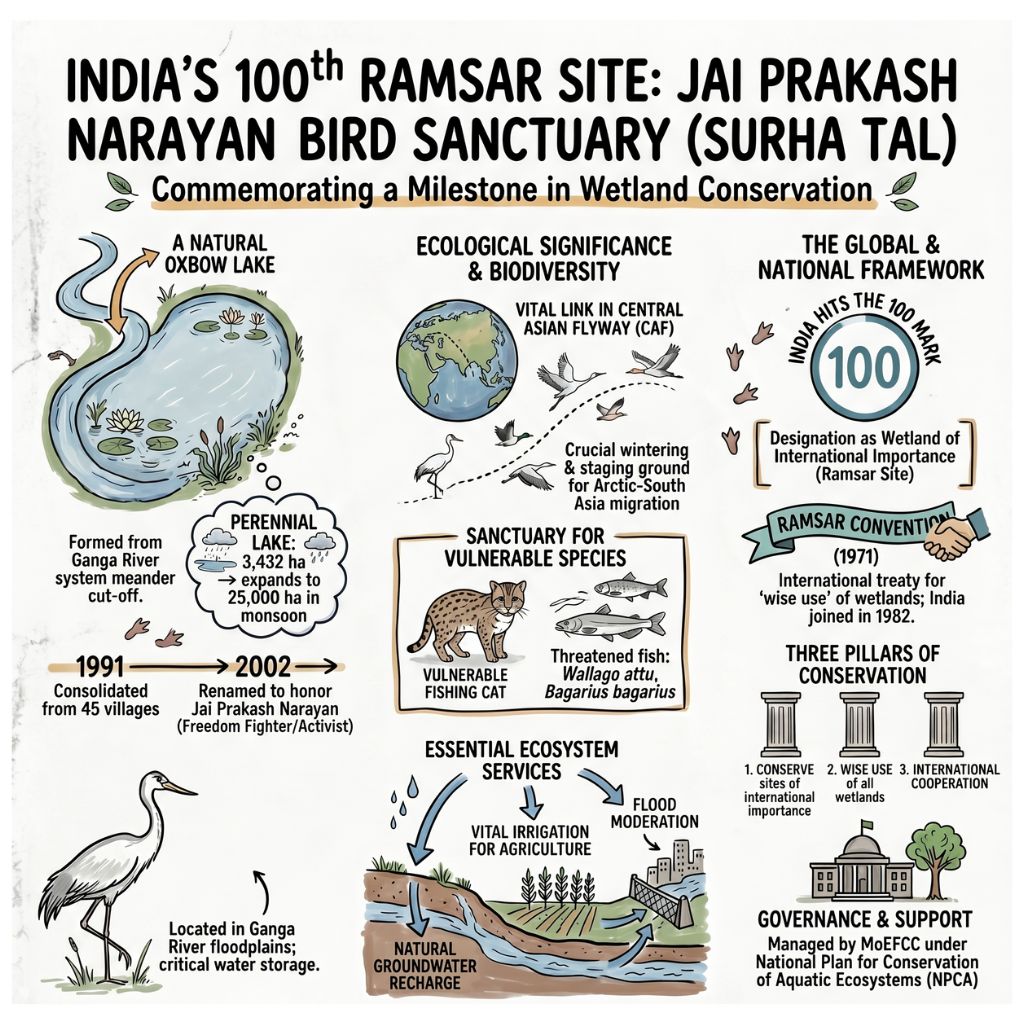
- Consolidated in 1991 from land areas of 45 villages as Surha Tal.
- Renamed in 2002 in honour of freedom fighter, social activist, and political leader Jai Prakash Narayan.
Key Features
- A natural perennial oxbow lake, formed when a river meander gets cut off from the main channel.
- Covers approximately 3,432 hectares.
- Expands up to 25,000 hectares during the monsoon season.
Ecological Significance
Important Bird Habitat
- Serves as a vital wintering and staging ground for migratory birds.
- Lies along the Central Asian Flyway (CAF), one of the world’s major migratory bird routes.
Rich Biodiversity
Fish Species
- Wallago attu (Vulnerable)
- Bagarius bagarius (Vulnerable)
Mammals
- Supports the vulnerable Fishing Cat due to abundant fish availability.
Ecosystem Services
- Groundwater recharge.
- Irrigation support for surrounding agricultural areas.
- Flood moderation and water storage.
- Conservation of aquatic biodiversity.
Cultural Importance
- Holds historical, religious, and socio-cultural significance for local communities.
About the Ramsar Convention
The Ramsar Convention on Wetlands is an international treaty for the conservation and wise use of wetlands and their resources.
History
- Adopted in Ramsar, Iran, in 1971.
- Came into force in 1975.
- India became a contracting party in 1982.
Three Pillars of the Convention
- Conservation of wetlands of international importance.
- Wise use of all wetlands.
- International cooperation on transboundary wetlands and migratory species.
Ramsar Site Criteria
- A wetland must satisfy at least one of nine criteria prescribed under the Convention.
- Criteria include ecological uniqueness, biodiversity value, support for threatened species, and importance for migratory birds.
Related Organizations and Schemes
Ministry of Environment, Forest and Climate Change (MoEFCC)
- Nodal ministry for Ramsar Site designation and wetland conservation in India.
National Plan for Conservation of Aquatic Ecosystems (NPCA)
- Centrally sponsored scheme for conservation and management of wetlands and lakes.
Central Asian Flyway (CAF)
- Major migratory route connecting Arctic and Central Asian breeding grounds with South Asia and the Indian Ocean region.
India’s 100th Ramsar Site Prelims Facts
- India now has 100 Ramsar Sites.
- Surha Tal is a natural oxbow lake.
- Located in Ballia district, Uttar Pradesh.
- Ramsar Convention adopted in 1971 at Ramsar, Iran.
- India joined the Convention in 1982.
- The Central Asian Flyway passes through India.
- Fishing Cat is classified as Vulnerable on the IUCN Red List.
- Ramsar Sites are wetlands of international importance.
