

Download Complete Environment and Ecology Notes PDF (Free)
If you are a serious aspirant preparing for government job competitive exams like UPSC, UPPSC, RPSC, BPSC, UKPSC, HPSC, MPPSC, SSC, or UPSSSC, you already know the harsh truth: the weightage of the Environment and Ecology section is skyrocketing. What used to be a fringe topic a decade ago now dictates whether you clear the preliminary cut-off or not.
With global climate summits, changing biodiversity laws, and new Ramsar sites making daily headlines, examiners are hunting for candidates with a rock-solid grasp of ecological principles. To give you the ultimate edge, our expert faculty has compiled the most exhaustive, rigorously fact-checked, and highly requested study guide.
In this mega-post, you will get access to the complete syllabus, and you can Download Environment and Ecology Notes PDF Free directly below. These notes are designed specifically to help you score maximum marks in both Prelims and Mains.
[👉 CLICK HERE TO DOWNLOAD ENVIRONMENT AND ECOLOGY NOTES PDF FREE]
Pro Tip: If the direct download link is busy due to high traffic, simply use your browser’s “Print” function (Ctrl+P / Cmd+P) and select “Save as PDF” to download this entire master guide for offline revision!
Why You Need These Environment and Ecology Notes for Competitive Exams
Before diving into the core concepts, let’s understand why this specific Environment and Ecology PDF for UPSC and State PCS is your golden ticket:
- Updated for 2026: We have included the latest data, including India’s 100 Ramsar Sites and 58 Tiger Reserves.
- Concept Clarity: From the intricacies of biogeochemical cycles to the subtle differences between niche and habitat, every concept is broken down for non-science background students.
- High ROI (Return on Investment): This single document covers static ecology, environmental laws, and international conventions—areas from which 15-20 questions are routinely asked in the UPSC IAS Prelims and State PCS exams.
Let’s begin the ultimate masterclass.
Chapter 1: Fundamentals of Environment and Ecology
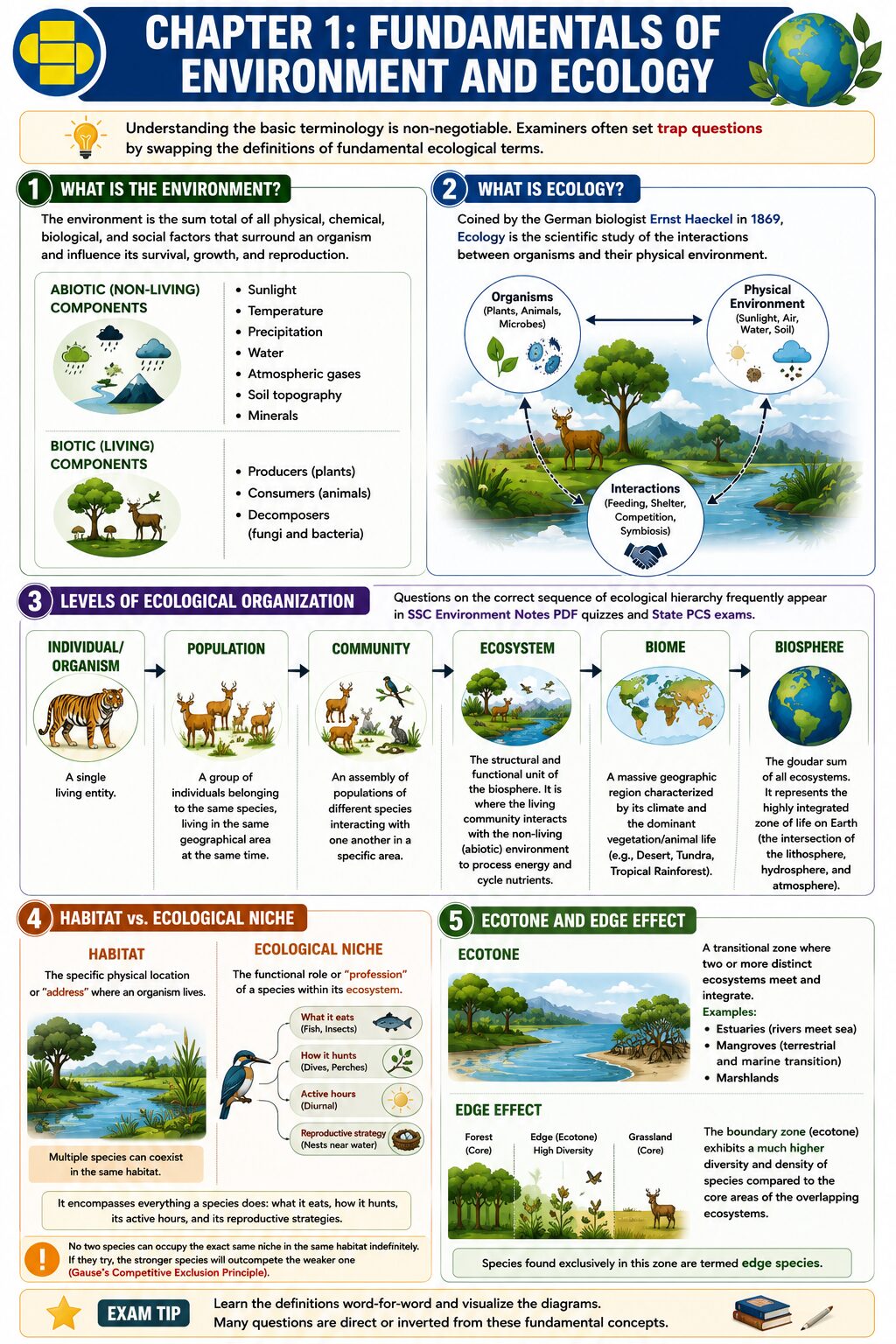
Understanding the basic terminology is non-negotiable. Examiners often set trap questions by swapping the definitions of fundamental ecological terms.
1. What is the Environment?
The environment is the sum total of all physical, chemical, biological, and social factors that surround an organism and influence its survival, growth, and reproduction.
- Abiotic (Non-living) Components: Sunlight, temperature, precipitation, water, atmospheric gases, soil topography, and minerals.
- Biotic (Living) Components: Producers (plants), consumers (animals), and decomposers (fungi and bacteria).
2. What is Ecology?
Coined by the German biologist Ernst Haeckel in 1869, Ecology is the scientific study of the interactions between organisms and their physical environment.
3. Levels of Ecological Organization
Questions on the correct sequence of ecological hierarchy frequently appear in SSC Environment Notes PDF quizzes and State PCS exams.
- Individual/Organism: A single living entity.
- Population: A group of individuals belonging to the same species, living in the same geographical area at the same time.
- Community: An assembly of populations of different species interacting with one another in a specific area.
- Ecosystem: The structural and functional unit of the biosphere. It is where the living community interacts with the non-living (abiotic) environment to process energy and cycle nutrients.
- Biome: A massive geographic region characterized by its climate and the dominant vegetation/animal life (e.g., Desert, Tundra, Tropical Rainforest).
- Biosphere: The global sum of all ecosystems. It represents the highly integrated zone of life on Earth (the intersection of the lithosphere, hydrosphere, and atmosphere).
4. Habitat vs. Ecological Niche
- Habitat: The specific physical location or “address” where an organism lives. Multiple species can coexist in the same habitat.
- Niche: The functional role or “profession” of a species within its ecosystem. It encompasses everything a species does: what it eats, how it hunts, its active hours, and its reproductive strategies. No two species can occupy the exact same niche in the same habitat indefinitely. If they try, the stronger species will outcompete the weaker one (Gause’s Competitive Exclusion Principle).
5. Ecotone and Edge Effect
- Ecotone: A transitional zone where two or more distinct ecosystems meet and integrate. Examples include estuaries (where rivers meet the sea), mangroves (transition between terrestrial and marine), and marshlands. Ecotones are zones of immense tension and high productivity.
- Edge Effect: The phenomenon where the boundary zone (ecotone) exhibits a much higher diversity and density of species compared to the core areas of the overlapping ecosystems. Species found exclusively in this zone are termed edge species.
Chapter 2: Ecosystem Dynamics (Energy Flow and Nutrient Cycling)
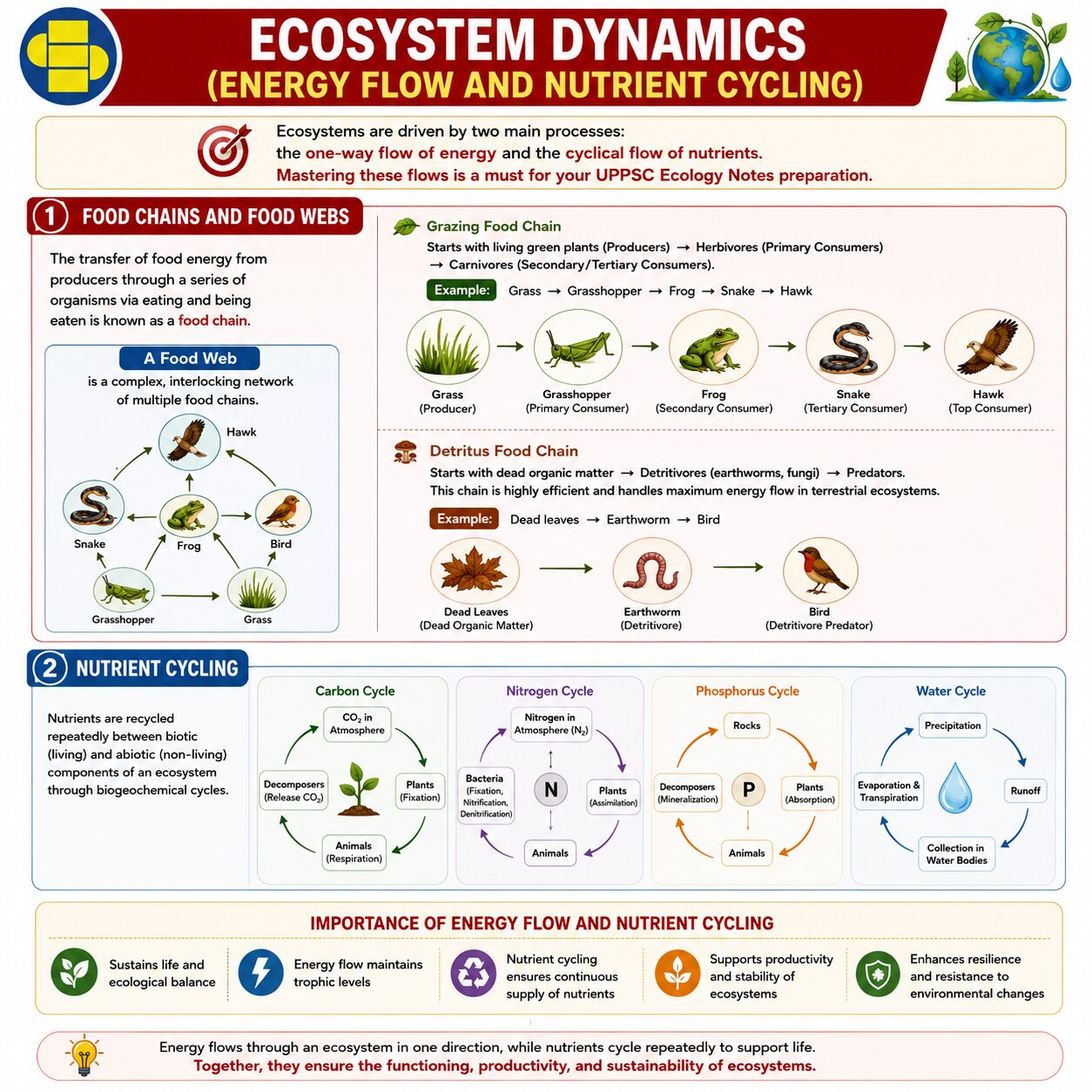
Ecosystems are driven by two main processes: the one-way flow of energy and the cyclical flow of nutrients. Mastering these flows is a must for your UPPSC Ecology Notes preparation.
1. Food Chains and Food Webs
The transfer of food energy from producers through a series of organisms via eating and being eaten is known as a food chain.
- Grazing Food Chain: Starts with living green plants (Producers) $\rightarrow$ Herbivores (Primary Consumers) $\rightarrow$ Carnivores (Secondary/Tertiary Consumers). Example: Grass–> Grasshopper–> Frog –> Snake –> Hawk.
- Detritus Food Chain: Starts with dead organic matter –> Detritivores (earthworms, fungi) –> Predators. This chain is highly efficient and handles maximum energy flow in terrestrial ecosystems.
A Food Web is a complex, interlocking network of multiple food chains. In nature, food webs are the reality because most organisms have alternative food sources, making the ecosystem more resilient to shocks.
2. Ecological Pyramids
Ecological pyramids are graphical representations of trophic levels in an ecosystem. This is a high-frequency topic in the BPSC Environment Notes.
- Pyramid of Numbers: Shows the population count at each level. It can be upright (grassland) or inverted (a single large tree supporting thousands of insects).
- Pyramid of Biomass: Shows the total dry weight of living organic matter. It is usually upright on land. However, in aquatic ecosystems, the pyramid of biomass is inverted because a small standing crop of phytoplankton supports a much larger biomass of zooplankton and fish.
- Pyramid of Energy: Shows the rate of energy flow. It is governed by Lindeman’s 10% Law (only 10% of energy transfers to the next trophic level; the rest is lost as heat). The pyramid of energy is always strictly upright.
3. Biogeochemical Cycle
- Carbon Cycle (Gaseous): Carbon cycles rapidly between the atmosphere, oceans, and biosphere. Oceans act as the largest active carbon sink.
- Nitrogen Cycle (Gaseous): Nitrogen (N2) comprises 78% of the air but is inert. It must be “fixed” into usable forms.
- Nitrogen Fixation: Conversion of N2 to ammonia (NH3) by lightning or bacteria like Rhizobium and Azotobacter.
- Nitrification: Ammonia is converted to nitrites (NO2^-) by Nitrosomonas, and then to nitrates (NO3^-) by Nitrobacter. Plants absorb nitrates.
- Denitrification: Pseudomonas bacteria convert soil nitrates back into atmospheric nitrogen gas, completing the cycle.
- Phosphorus Cycle (Sedimentary): A very slow cycle that mostly occurs through rock weathering, soil, and aquatic sediments. It has virtually no atmospheric gaseous phase.
[👉 DOWNLOAD ENVIRONMENT AND ECOLOGY NOTES PDF FREE HERE]
Keep scrolling to master Biodiversity, Pollution, and Climate Change—the pillars of the UPSC Mains syllabus.
Chapter 3: Biodiversity and Conservation in India (2026 Updates)
For any aspirant looking for the best environment and ecology notes for civil services, keeping data updated is the biggest challenge. The data below is strictly updated as of 2026.
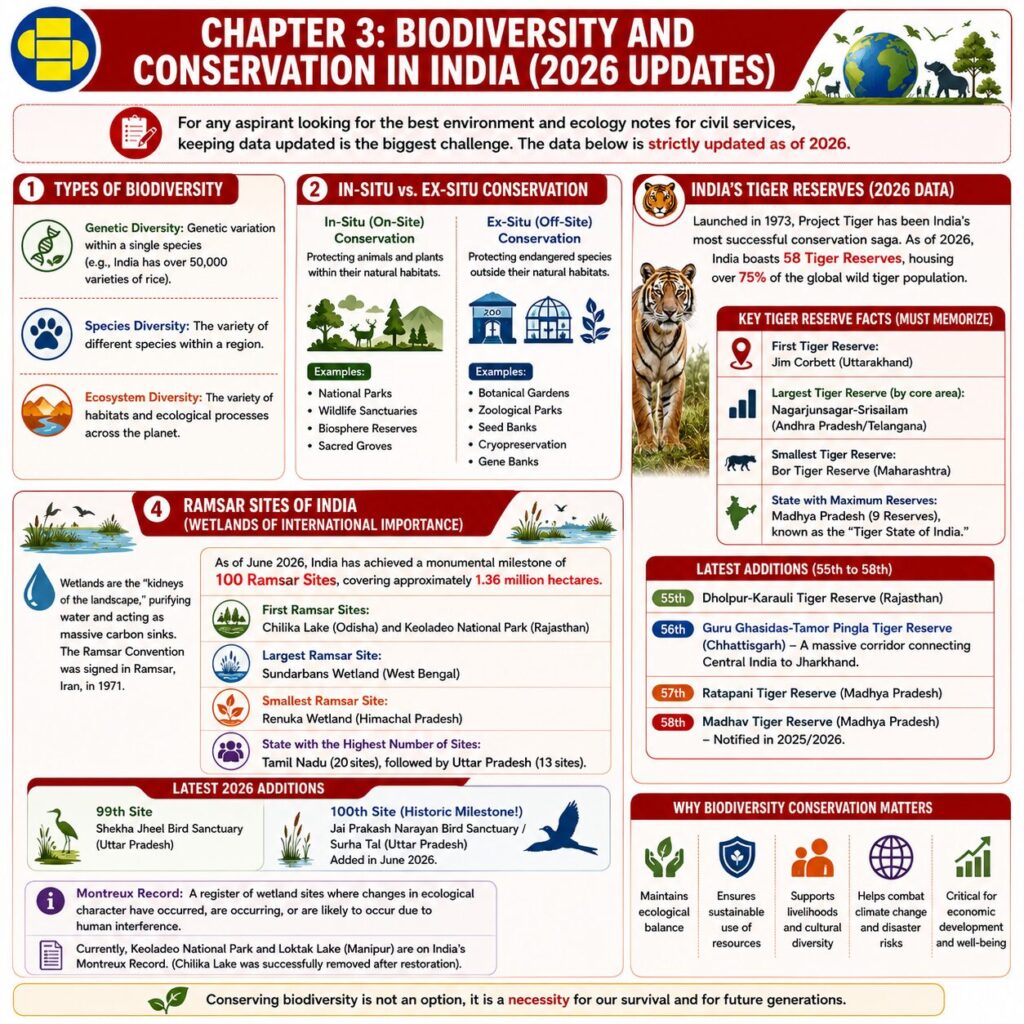
1. Types of Biodiversity
- Genetic Diversity: Genetic variation within a single species (e.g., India has over 50,000 varieties of rice).
- Species Diversity: The variety of different species within a region.
- Ecosystem Diversity: The variety of habitats and ecological processes across the planet.
2. In-Situ vs. Ex-Situ Conservation
- In-Situ (On-Site) Conservation: Protecting animals and plants within their natural habitats. Examples: National Parks, Wildlife Sanctuaries, Biosphere Reserves, Sacred Groves.
- Ex-Situ (Off-Site) Conservation: Protecting endangered species outside their natural habitats. Examples: Botanical Gardens, Zoological Parks, Seed Banks, Cryopreservation, and Gene Banks.
3. India’s Tiger Reserves (Project Tiger 2026 Data)
Launched in 1973, Project Tiger has been India’s most successful conservation saga. As of 2026, India boasts 58 Tiger Reserves, housing over 75% of the global wild tiger population.
Key Tiger Reserve Facts (Must Memorize):
- First Tiger Reserve: Jim Corbett (Uttarakhand).
- Largest Tiger Reserve (by core area): Nagarjunsagar-Srisailam (Andhra Pradesh/Telangana).
- Smallest Tiger Reserve: Bor Tiger Reserve (Maharashtra).
- State with Maximum Reserves: Madhya Pradesh (9 Reserves), known as the “Tiger State of India.”
- Latest Additions (55th to 58th):
- 55th: Dholpur-Karauli (Rajasthan)
- 56th: Guru Ghasidas-Tamor Pingla (Chhattisgarh) – A massive corridor connecting Central India to Jharkhand.
- 57th: Ratapani Tiger Reserve (Madhya Pradesh)
- 58th: Madhav Tiger Reserve (Madhya Pradesh) – Notified in 2025/2026.
4. Ramsar Sites of India (Wetlands of International Importance)
Wetlands are the “kidneys of the landscape,” purifying water and acting as massive carbon sinks. The Ramsar Convention was signed in Ramsar, Iran, in 1971.
As of June 2026, India has achieved a monumental milestone of 100 Ramsar Sites, covering approximately 1.36 million hectares.
Key Ramsar Facts (2026 Data):
- First Ramsar Sites: Chilika Lake (Odisha) and Keoladeo National Park (Rajasthan).
- Largest Ramsar Site: Sundarbans Wetland (West Bengal).
- Smallest Ramsar Site: Renuka Wetland (Himachal Pradesh).
- State with the Highest Number of Sites: Tamil Nadu (20 sites), followed by Uttar Pradesh (13 sites).
- Latest 2026 Additions: The 99th site is Shekha Jheel Bird Sanctuary (Uttar Pradesh), and the historic 100th site is Jai Prakash Narayan Bird Sanctuary / Surha Tal (Uttar Pradesh), added in June 2026.
- Montreux Record: A register of wetland sites where changes in ecological character have occurred, are occurring, or are likely to occur due to human interference. Currently, Keoladeo National Park and Loktak Lake (Manipur) are on India’s Montreux Record. (Chilika Lake was successfully removed after restoration).
Chapter 4: Environmental Pollution
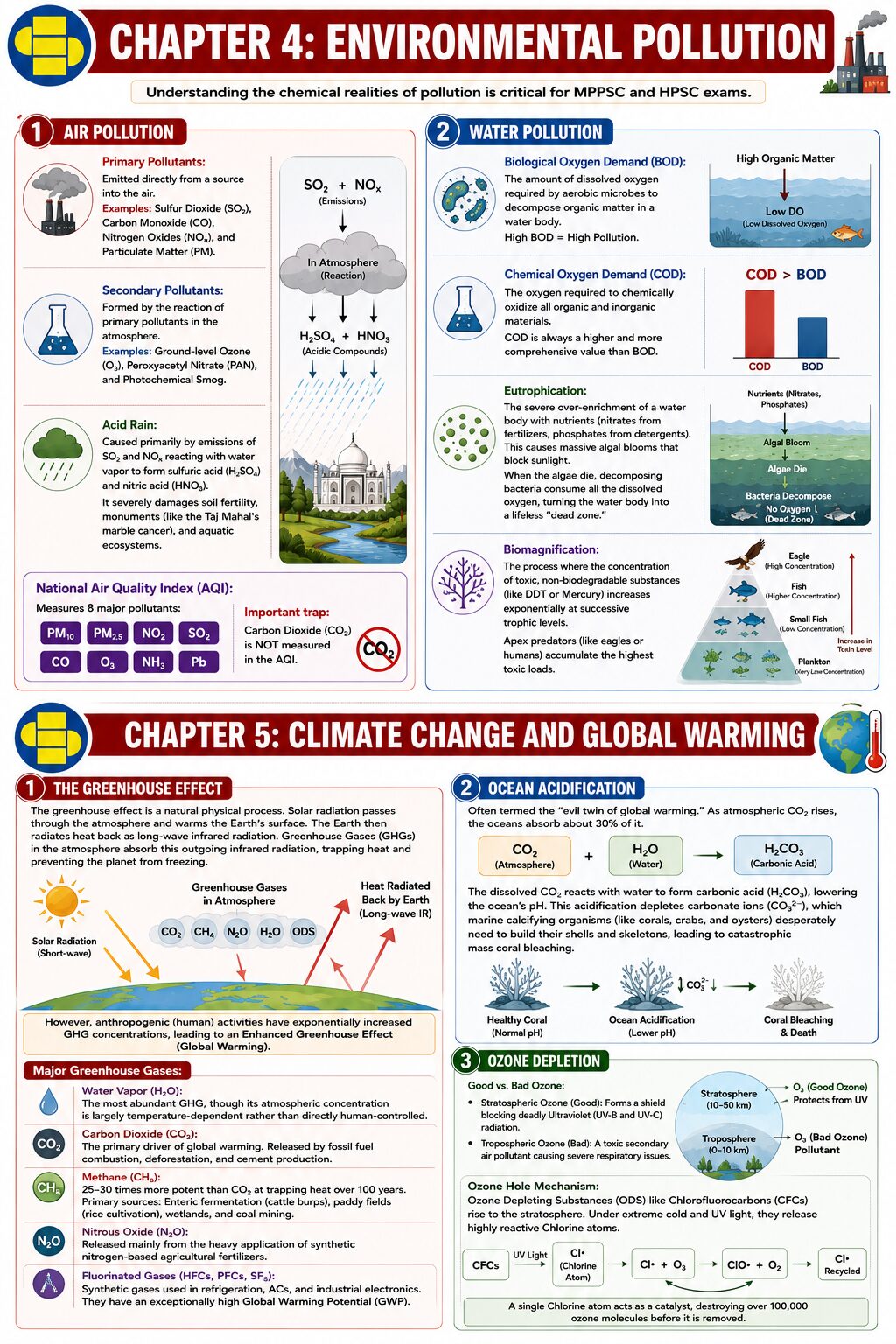
Understanding the chemical realities of pollution is critical for MPPSC and HPSC exams.
1. Air Pollution
- Primary Pollutants: Emitted directly from a source into the air. Examples: Sulfur Dioxide (SO2), Carbon Monoxide (CO), Nitrogen Oxides (NOx), and Particulate Matter (PM).
- Secondary Pollutants: Formed by the reaction of primary pollutants in the atmosphere. Examples: Ground-level Ozone ($O_3$), Peroxyacetyl Nitrate (PAN), and Photochemical Smog.
- Acid Rain: Caused primarily by emissions of SO2 and NOx reacting with water vapor to form sulfuric acid (H2SO4) and nitric acid (HNO3). It severely damages soil fertility, monuments (like the Taj Mahal’s marble cancer), and aquatic ecosystems.
- National Air Quality Index (AQI): Measures 8 major pollutants: PM10, PM2.5, NO2, SO2, CO, O3, NH3 (Ammonia), Pb (Lead). Important trap: Carbon Dioxide (CO2) is NOT measured in the AQI.
2. Water Pollution
- Biological Oxygen Demand (BOD): The amount of dissolved oxygen required by aerobic microbes to decompose organic matter in a water body. High BOD = High Pollution.
- Chemical Oxygen Demand (COD): The oxygen required to chemically oxidize all organic and inorganic materials. COD is always a higher and more comprehensive value than BOD.
- Eutrophication: The severe over-enrichment of a water body with nutrients (nitrates from fertilizers, phosphates from detergents). This causes massive algal blooms that block sunlight. When the algae die, decomposing bacteria consume all the dissolved oxygen, turning the water body into a lifeless “dead zone.”
- Biomagnification: The process where the concentration of toxic, non-biodegradable substances (like DDT or Mercury) increases exponentially at successive trophic levels. Apex predators (like eagles or humans) accumulate the highest toxic loads.
Chapter 5: Climate Change and Global Warming
Global warming is the crux of modern Environment and Ecology PDF for UPSC materials.
1. The Greenhouse Effect
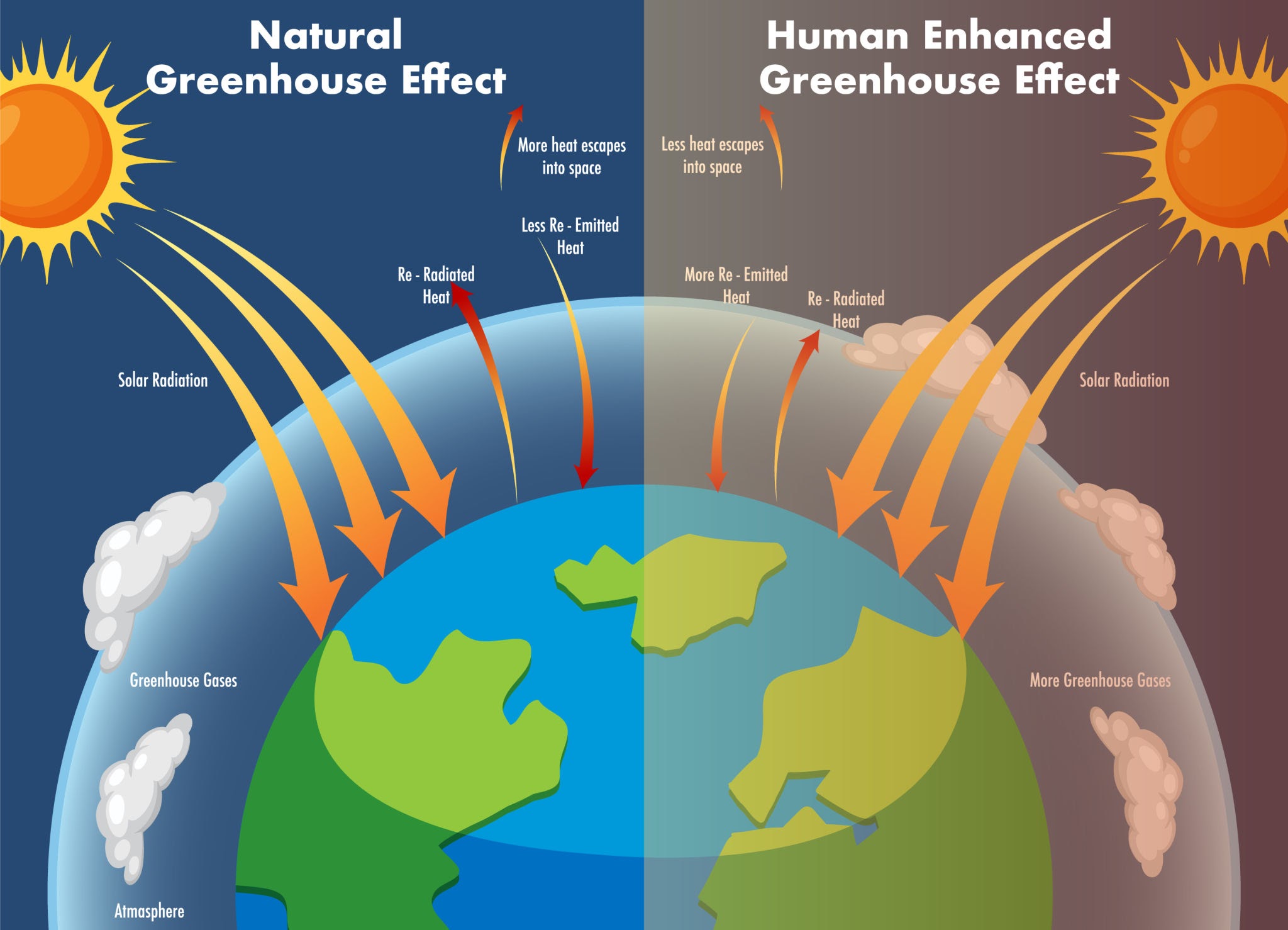
The greenhouse effect is a natural physical process. Solar radiation passes through the atmosphere and warms the Earth’s surface. The Earth then radiates heat back as long-wave infrared radiation. Greenhouse Gases (GHGs) in the atmosphere absorb this outgoing infrared radiation, trapping heat and preventing the planet from freezing.
However, anthropogenic (human) activities have exponentially increased GHG concentrations, leading to an Enhanced Greenhouse Effect (Global Warming).
Major Greenhouse Gases:
- Water Vapor: The most abundant GHG, though its atmospheric concentration is largely temperature-dependent rather than directly human-controlled.
- Carbon Dioxide (CO_2): The primary driver of global warming. Released by fossil fuel combustion, deforestation, and cement production.
- Methane (CH_4): 25-30 times more potent than $CO_2$ at trapping heat over 100 years. Primary sources: Enteric fermentation (cattle burps), paddy fields (rice cultivation), wetlands, and coal mining.
- Nitrous Oxide (N_2O): Released mainly from the heavy application of synthetic nitrogen-based agricultural fertilizers.
- Fluorinated Gases (HFCs, PFCs, SF_6): Synthetic gases used in refrigeration, ACs, and industrial electronics. They have an exceptionally high Global Warming Potential (GWP).
2. Ocean Acidification
Often termed the “evil twin of global warming.” As atmospheric $CO_2$ rises, the oceans absorb about 30% of it. The dissolved $CO_2$ reacts with water to form carbonic acid ($H_2CO_3$), lowering the ocean’s pH. This acidification depletes carbonate ions, which marine calcifying organisms (like corals, crabs, and oysters) desperately need to build their shells and skeletons, leading to catastrophic mass coral bleaching.
3. Ozone Depletion
- Good vs. Bad Ozone: Ozone in the stratosphere (upper atmosphere) is “good” because it forms a shield blocking deadly Ultraviolet (UV-B and UV-C) radiation. Ozone in the troposphere (ground level) is “bad” because it is a toxic secondary air pollutant causing severe respiratory issues.
- Ozone Hole Mechanism: Ozone Depleting Substances (ODS) like Chlorofluorocarbons (CFCs) rise to the stratosphere. Under extreme cold and UV light, they release highly reactive Chlorine atoms. A single Chlorine atom acts as a catalyst, destroying over 100,000 ozone molecules before it is removed.
[👉 CLICK HERE TO DOWNLOAD ENVIRONMENT AND ECOLOGY NOTES PDF FREE]
Your ultimate resource for State Civil Services Exams, SSC, and UPSSSC. Read on for the final highly scoring chapters on Laws and Conventions.
Chapter 6: Environmental Laws and Acts in India
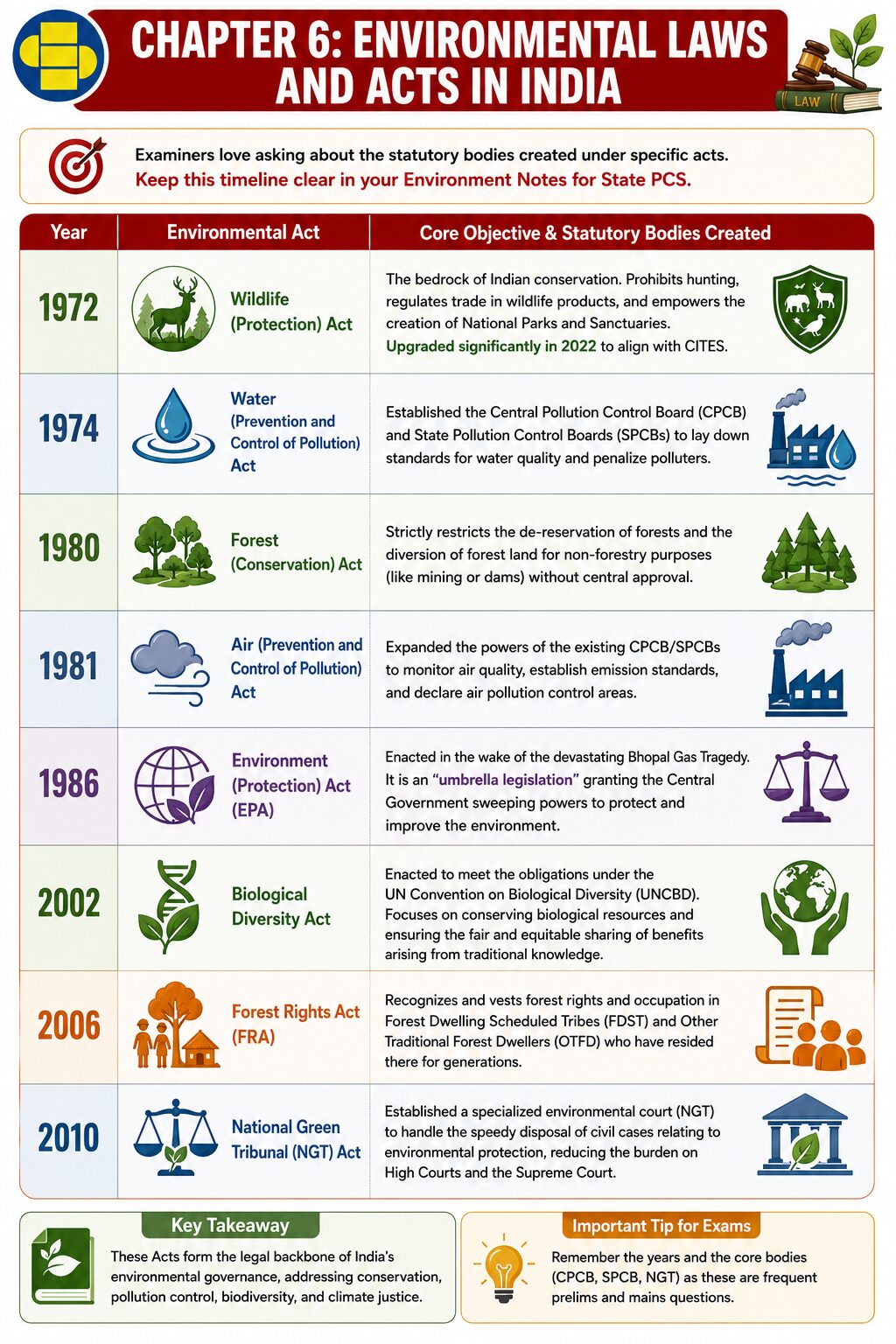
Examiners love asking about the statutory bodies created under specific acts. Keep this timeline clear in your Environment Notes for State PCS.
| Year | Environmental Act | Core Objective & Statutory Bodies Created |
| 1972 | Wildlife (Protection) Act | The bedrock of Indian conservation. Prohibits hunting, regulates trade in wildlife products, and empowers the creation of National Parks and Sanctuaries. Upgraded significantly in 2022 to align with CITES. |
| 1974 | Water (Prevention and Control of Pollution) Act | Established the Central Pollution Control Board (CPCB) and State Pollution Control Boards (SPCBs) to lay down standards for water quality and penalize polluters. |
| 1980 | Forest (Conservation) Act | Strictly restricts the de-reservation of forests and the diversion of forest land for non-forestry purposes (like mining or dams) without central approval. |
| 1981 | Air (Prevention and Control of Pollution) Act | Expanded the powers of the existing CPCB/SPCBs to monitor air quality, establish emission standards, and declare air pollution control areas. |
| 1986 | Environment (Protection) Act (EPA) | Enacted in the wake of the devastating Bhopal Gas Tragedy. It is an “umbrella legislation” granting the Central Government sweeping powers to protect and improve the environment. |
| 2002 | Biological Diversity Act | Enacted to meet the obligations under the UN Convention on Biological Diversity (UNCBD). Focuses on conserving biological resources and ensuring the fair and equitable sharing of benefits arising from traditional knowledge. |
| 2006 | Forest Rights Act (FRA) | Recognizes and vests forest rights and occupation in Forest Dwelling Scheduled Tribes (FDST) and Other Traditional Forest Dwellers (OTFD) who have resided there for generations. |
| 2010 | National Green Tribunal (NGT) Act | Established a specialized environmental court (NGT) to handle the speedy disposal of civil cases relating to environmental protection, reducing the burden on High Courts and the Supreme Court. |
Chapter 7: International Environmental Conventions and Protocols
The global fight against environmental degradation is governed by international treaties. Matching the treaty to its purpose is a guaranteed 2-mark question in the UPSC Prelims.
1. The Rio Earth Summit (1992)
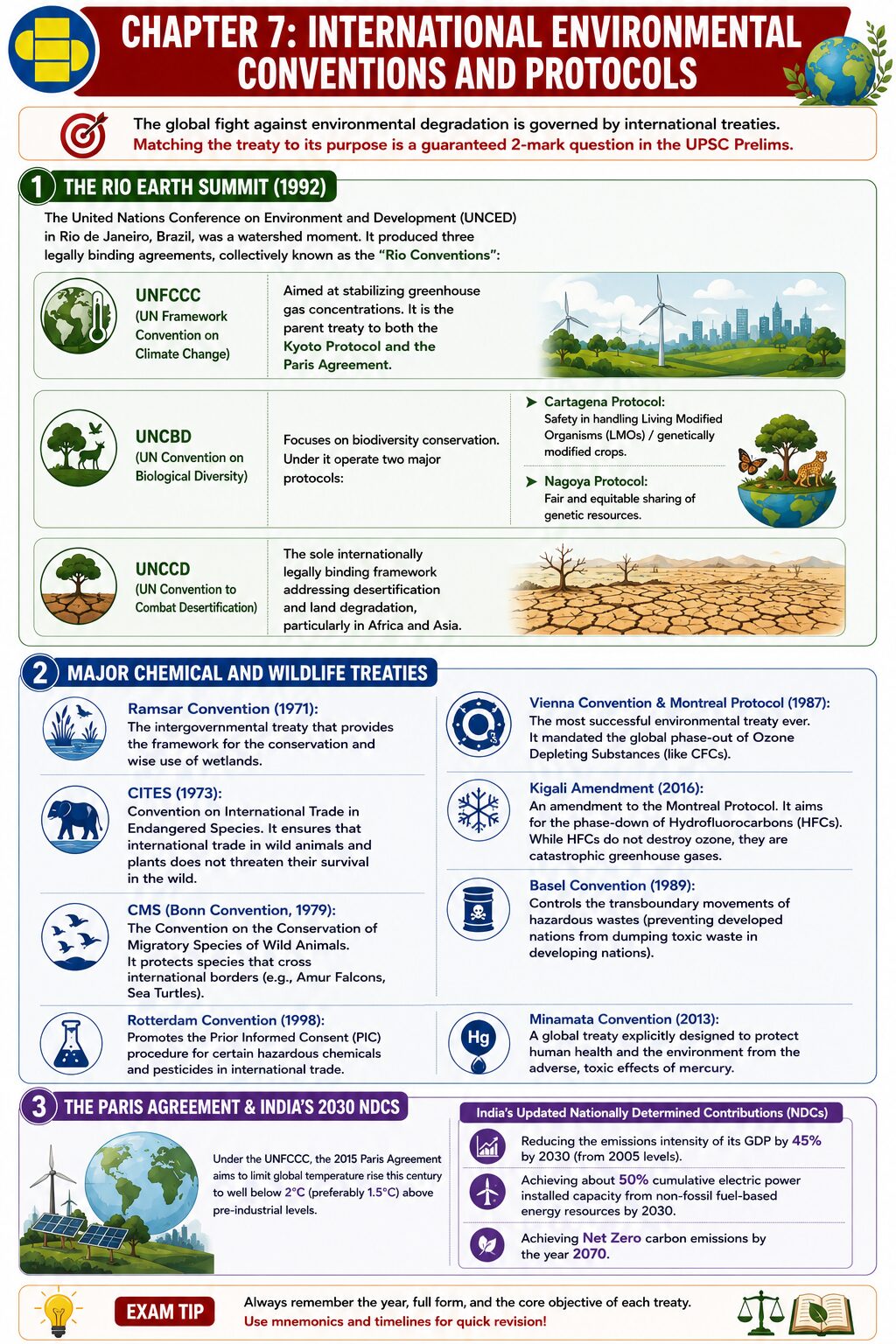
The United Nations Conference on Environment and Development (UNCED) in Rio de Janeiro, Brazil, was a watershed moment. It produced three legally binding agreements, collectively known as the “Rio Conventions”:
- UNFCCC (UN Framework Convention on Climate Change): Aimed at stabilizing greenhouse gas concentrations. It is the parent treaty to both the Kyoto Protocol and the Paris Agreement.
- UNCBD (UN Convention on Biological Diversity): Focuses on biodiversity conservation. Under it operate two major protocols:
- Cartagena Protocol: Safety in handling Living Modified Organisms (LMOs) / genetically modified crops.
- Nagoya Protocol: Fair and equitable sharing of genetic resources.
- UNCCD (UN Convention to Combat Desertification): The sole internationally legally binding framework addressing desertification and land degradation, particularly in Africa and Asia.
2. Major Chemical and Wildlife Treaties
- Ramsar Convention (1971): The intergovernmental treaty that provides the framework for the conservation and wise use of wetlands.
- CITES (1973): Convention on International Trade in Endangered Species. It ensures that international trade in wild animals and plants does not threaten their survival in the wild.
- CMS (Bonn Convention, 1979): The Convention on the Conservation of Migratory Species of Wild Animals. It protects species that cross international borders (e.g., Amur Falcons, Sea Turtles).
- Vienna Convention & Montreal Protocol (1987): The most successful environmental treaty ever. It mandated the global phase-out of Ozone Depleting Substances (like CFCs).
- Kigali Amendment (2016): An amendment to the Montreal Protocol. It aims for the phase-down of Hydrofluorocarbons (HFCs). While HFCs do not destroy ozone, they are catastrophic greenhouse gases.
- Basel Convention (1989): Controls the transboundary movements of hazardous wastes (preventing developed nations from dumping toxic waste in developing nations).
- Rotterdam Convention (1998): Promotes the Prior Informed Consent (PIC) procedure for certain hazardous chemicals and pesticides in international trade.
- Minamata Convention (2013): A global treaty explicitly designed to protect human health and the environment from the adverse, toxic effects of mercury.
3. The Paris Agreement & India’s 2030 NDCs
Under the UNFCCC, the 2015 Paris Agreement aims to limit global temperature rise this century to well below 2°C (preferably 1.5°C) above pre-industrial levels.
India’s updated Nationally Determined Contributions (NDCs) emphasize:
- Reducing the emissions intensity of its GDP by 45% by 2030 (from 2005 levels).
- Achieving about 50% cumulative electric power installed capacity from non-fossil fuel-based energy resources by 2030.
- Achieving Net Zero carbon emissions by the year 2070.
Frequently Asked Questions (FAQs) for Exam Aspirants
Absolutely. These notes cover the exhaustive static syllabus. However, for UPSC Mains, you must link these static concepts (like the Forest Conservation Act) with dynamic current affairs (like recent Supreme Court judgments on forest definitions).
As of June 2026, India officially has 58 Tiger Reserves (the newest being Madhav Tiger Reserve in Madhya Pradesh) and 100 Ramsar Sites (the 100th being Jai Prakash Narayan Bird Sanctuary / Surha Tal in UP).
UPPSC, MPPSC, BPSC, and RPSC have significantly increased their ecology weightage. In MPPSC, specialized questions on Madhya Pradesh’s 9 tiger reserves are guaranteed. In UPPSC, questions on UP’s 13 Ramsar sites are highly prevalent.
Do not rote-learn every detail. Focus on: The year of inception, the primary objective (e.g., Minamata = Mercury, Basel = Hazardous Waste), and whether it is legally binding or voluntary.
Final Strategy and PDF Download
Studying Environment and Ecology without a structured approach is like wandering through a dense forest without a compass. You must approach this subject chronologically: Understand the basic ecosystem dynamics $\rightarrow$ learn how biodiversity functions within it $\rightarrow$ study the pollution and climate change destroying it $\rightarrow$ memorize the laws and conventions created to save it.
Do not let scattered study materials cost you your dream government job. Consolidate your preparation today.
👉 Ready to Accelerate Your Preparation?
[⬇️ DOWNLOAD ENVIRONMENT AND ECOLOGY NOTES PDF FREE NOW ⬇️]
(Use your browser’s Print to PDF feature to save this comprehensive, 4000-word masterclass directly to your device for unlimited, lifetime offline access. Share this page with your fellow aspirants to help them succeed in the upcoming 2026-2027 competitive exam cycles!)
