

Biosphere Reserves of India: Complete List, UNESCO Status & Key Facts
India, recognized globally as one of the 17 megadiverse countries, boasts an extraordinary ecological spectrum. From the freezing trans-Himalayan heights and dense tropical rainforests to sprawling mangroves, vibrant coral reefs, and vast seasonal salt marshes, the subcontinent is a living laboratory of biodiversity. Biosphere Reserves in India serve as crucial landscapes that not only protect these diverse ecosystems but also harmonize human development with nature through scientific research and community participation.
Presently, the Government of India has formally designated 18 Biosphere Reserves spread across varied biogeographical zones. Out of these, a prestigious 13 Biosphere Reserves have been inducted into UNESCO’s World Network of Biosphere Reserves (WNBR).
The Nilgiri Biosphere Reserve holds the historic distinction of being India’s first, established in 1986. The Cold Desert Biosphere Reserve is the most recent Indian addition to the UNESCO World Network, achieving this status in 2025.
For aspirants of UPSC, UPPSC, and other state civil services, this topic is exceptionally high-yield. It intrinsically links multiple syllabus domains: environment, geography, river systems, indigenous tribes, international environmental conventions, and dynamic current affairs.
What Exactly is a Biosphere Reserve?
A Biosphere Reserve (BR) is a vast, representative segment of a natural landscape—terrestrial, coastal, or marine—where the preservation of biological diversity is deeply integrated with the sustainable, economic use of natural resources.
While National Parks prioritize strict, exclusionary conservation, Biosphere Reserves adopt a more holistic, inclusive approach. They are conceived to act as “learning places for sustainable development,” accommodating localized economic activities, extensive scientific research, and environmental education alongside rigorous habitat protection.
The conceptual framework for Biosphere Reserves was pioneered by the United Nations Educational, Scientific and Cultural Organization (UNESCO) under its Man and the Biosphere (MAB) Programme, an intergovernmental scientific initiative launched in 1971.
The Three Core Functions
Every designated Biosphere Reserve is expected to fulfill three complementary and mutually reinforcing functions:
- Conservation Function: Safeguarding ecosystems, endemic landscapes, vulnerable species, and invaluable genetic diversity against degradation.
- Development Function: Fostering economic and human development that is socioculturally and ecologically sustainable (e.g., promoting local handicrafts, organic farming, and eco-tourism).
- Logistic Support Function: Providing infrastructure and networks for environmental education, ongoing scientific research, and systematic monitoring of global conservation issues.
Zonation Architecture of Biosphere Reserves
To balance human presence with wilderness protection, a Biosphere Reserve is spatially delineated into three interconnected zones:
- Core Zone: The innermost, most strictly protected sanctum. Human interference is virtually zero, barring non-destructive scientific monitoring. It acts as a secure refuge for endemic species and critical genetic repositories.
- Buffer Zone: Enveloping or adjoining the core zone. Here, activities are regulated so they do not hinder the conservation objectives of the core. Allowed activities include applied research, environmental education, regulated grazing, and eco-tourism.
- Transition Zone (Area of Cooperation): The outermost periphery where human enterprises and conservation merge in harmony. It contains agricultural lands, human settlements, and localized industries managed sustainably by local communities, forest departments, and NGOs.
The Blueprint: Core Zone → Buffer Zone → Transition Zone
North-to-South Alignment of BRs of India
When tracing a physical map of India from the northernmost latitudes to the deep south, the Biosphere Reserves align in approximately this sequence:
- Cold Desert (Himachal Pradesh)
- Nanda Devi (Uttarakhand)
- Dihang-Dibang (Arunachal Pradesh)
- Khangchendzonga (Sikkim)
- Dibru-Saikhowa (Assam)
- Manas (Assam)
- Nokrek (Meghalaya)
- Panna (Madhya Pradesh)
- Great Rann of Kutch (Gujarat)
- Pachmarhi (Madhya Pradesh)
- Achanakmar-Amarkantak (Madhya Pradesh/Chhattisgarh)
- Similipal (Odisha)
- Sundarbans (West Bengal)
- Seshachalam Hills (Andhra Pradesh)
- Nilgiri (Karnataka/Kerala/Tamil Nadu)
- Gulf of Mannar (Tamil Nadu)
- Agasthyamalai (Kerala/Tamil Nadu)
- Great Nicobar (Andaman & Nicobar Islands)
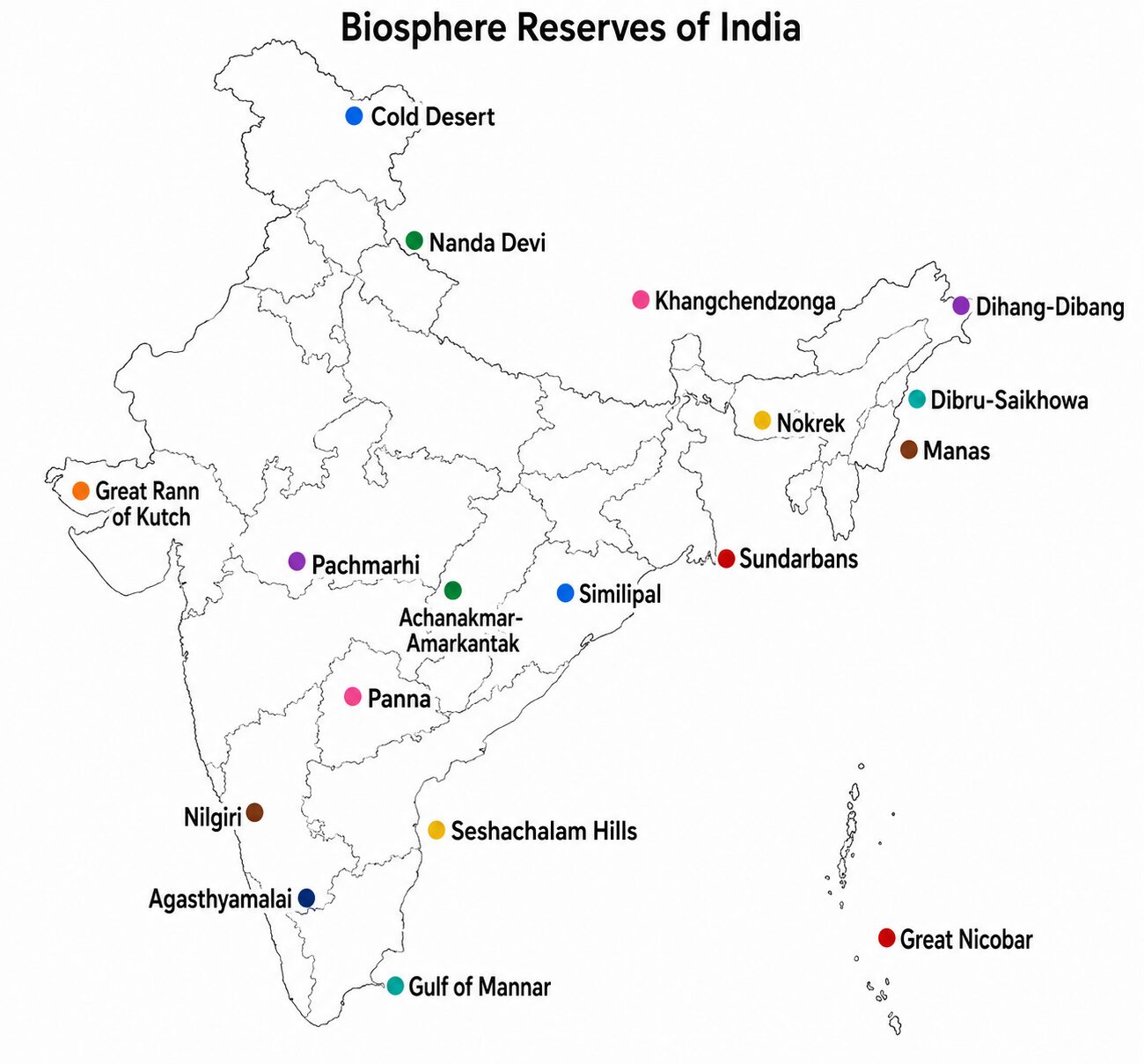
Complete List of India’s 18 Biosphere Reserves
| Biosphere Reserve | State/UT | Designation Year | UNESCO WNBR | Dominant Ecosystem / Key Feature |
| Nilgiri | Tamil Nadu, Kerala, Karnataka | 1986 | 2000 | Western Ghats meeting Eastern Ghats; Shola forests |
| Nanda Devi | Uttarakhand | 1988 | 2004 | High Western Himalayas; Alpine meadows |
| Nokrek | Meghalaya | 1988 | 2009 | Garo Hills; Citrus gene pool sanctuary |
| Gulf of Mannar | Tamil Nadu | 1989 | 2001 | Coastal and marine; Dugong habitat |
| Sundarbans | West Bengal | 1989 | 2001 | World’s largest estuarine mangrove delta |
| Manas | Assam | 1989 | Not included | Terai region; Himalayan foothill grasslands |
| Great Nicobar | Andaman & Nicobar | 1989 | 2013 | Tropical island rainforests; Shompen tribe |
| Similipal | Odisha | 1994 | 2009 | Chotanagpur plateau extension; Sal forests |
| Dibru-Saikhowa | Assam | 1997 | Not included | Brahmaputra/Lohit floodplains; Riverine islands |
| Dihang-Dibang | Arunachal Pradesh | 1998 | Not included | Eastern Himalayas; Extreme altitudinal gradients |
| Pachmarhi | Madhya Pradesh | 1999 | 2009 | Satpura ranges; Deep sandstone gorges |
| Khangchendzonga | Sikkim | 2000 | 2018 | Eastern Himalayas; Zemu glacier; Sacred landscapes |
| Agasthyamalai | Kerala, Tamil Nadu | 2001 | 2016 | Southern Western Ghats; Endemic medicinal herbs |
| Achanakmar-Amarkantak | Chhattisgarh, Madhya Pradesh | 2005 | 2012 | Maikal Hills; Origin point of Narmada and Son rivers |
| Great Rann of Kutch | Gujarat | 2008 | Not included | Seasonal saline marshland; Banni grasslands |
| Cold Desert | Himachal Pradesh | 2009 | 2025 | Trans-Himalayan arid zones; Spiti valley |
| Seshachalam Hills | Andhra Pradesh | 2010 | Not included | Eastern Ghats; Endemic Red Sanders flora |
| Panna | Madhya Pradesh | 2011 | 2020 | Vindhyan hill ranges; Ken River corridor |
In-Depth Profile of Each Biosphere Reserve
1. Nilgiri Biosphere Reserve
- Establishment & Status: 1986 (India’s first Biosphere Reserve). Inducted into UNESCO WNBR in 2000.
- Geography: Spanning Tamil Nadu, Kerala, and Karnataka, it acts as the ecological bridge where the Western Ghats meet the Eastern Ghats. It is carved by the Moyar, Bhavani, and Kabini rivers.
- Protected Sub-Units: Encompasses Mudumalai, Bandipur, Nagarhole, Silent Valley, and Mukurthi National Parks, alongside Wayanad Wildlife Sanctuary.
- Flora & Fauna: Renowned for the highly specialized Shola-Grassland ecosystem. It provides critical refuge for the endangered Lion-tailed Macaque, Nilgiri Tahr, Bengal Tiger, and Asian Elephant.
- Indigenous Communities: Home to ancient tribal groups including the Toda, Kota, Irula, and Kurumba.
2. Nanda Devi Biosphere Reserve
- Establishment & Status: 1988 (UNESCO WNBR in 2004).
- Geography: Located in Uttarakhand. Represents a breathtaking Western Himalayan high-altitude ecosystem. Anchored by the Nanda Devi massif (India’s second-highest mountain), it features the Rishi Ganga Gorge, Dhauli Ganga basin, and alpine meadows locally known as Bugyals.
- Protected Sub-Units: Nanda Devi and Valley of Flowers National Parks (jointly designated a UNESCO World Heritage property).
- Flora & Fauna: Famous for over 300 varieties of alpine flowering plants. Key fauna include the elusive Snow Leopard, Himalayan Musk Deer, Himalayan Black Bear, and Bharal (Blue Sheep).
3. Nokrek Biosphere Reserve
- Establishment & Status: 1988 (UNESCO WNBR in 2009).
- Geography: Situated in the Garo Hills of Meghalaya. The Simsang river originates here.
- Protected Sub-Units: Nokrek National Park.
- Flora & Fauna: A biological treasure trove, it is the world’s most vital sanctuary for wild citrus genetic resources, particularly Citrus indica (Indian wild orange). It also hosts the Hoolock Gibbon (India’s only ape), Asian Elephant, and Clouded Leopard.
4. Gulf of Mannar Biosphere Reserve
- Establishment & Status: 1989 (UNESCO WNBR in 2001).
- Geography: Located along the southeastern coast of Tamil Nadu (Ramanathapuram and Thoothukudi districts), stretching toward Sri Lanka. Comprises coral reefs, expansive seagrass meadows, mangroves, and an archipelago of 21 islands.
- Protected Sub-Units: Gulf of Mannar Marine National Park.
- Flora & Fauna: It is famously recognized for the conservation of the Dugong (Sea Cow), an endangered marine herbivore highly dependent on the seagrass ecosystems. It also protects sea turtles, seahorses, and diverse reef fish.
5. Sundarbans Biosphere Reserve
- Establishment & Status: 1989 (UNESCO WNBR in 2001).
- Geography: West Bengal. A critical segment of the massive Ganga-Brahmaputra-Meghna delta. Shaped by relentless tidal action, it boasts intricate mudflats and tidal creeks (Matla, Bidyadhari rivers).
- Protected Sub-Units: Sundarbans National Park, and Sajnekhali, Lothian Island, and Haliday Island Wildlife Sanctuaries.
- Flora & Fauna: The only mangrove ecosystem globally where the Royal Bengal Tiger is endemic. Known for pneumatophores (breathing roots) in species like Sundari (Heritiera fomes). Also home to Estuarine Crocodiles and the Fishing Cat.
6. Manas Biosphere Reserve
- Establishment & Status: 1989.
- Geography: Assam. Lying in the Himalayan foothills (Terai region), it forms a transboundary contiguous landscape with Bhutan’s Royal Manas National Park. The Manas River (a Brahmaputra tributary) flows through its core.
- Protected Sub-Units: Manas National Park (also a Tiger Reserve and Elephant Reserve).
- Key Fauna: Extremely rich in endemism. It is the vital stronghold for the critically endangered Pygmy Hog, Hispid Hare, Golden Langur, and Bengal Florican, alongside rhinos and tigers.
7. Great Nicobar Biosphere Reserve
- Establishment & Status: 1989 (UNESCO WNBR in 2013).
- Geography: Andaman & Nicobar Islands. Encompasses the majority of the southernmost island in the archipelago, characterized by dense tropical evergreen rainforests, Mount Thullier, and the Galathea River.
- Protected Sub-Units: Campbell Bay National Park, Galathea Bay National Park.
- Flora & Fauna: Home to the endemic Nicobar Megapode, Nicobar Tree Shrew, and giant Leatherback Sea Turtles.
- Indigenous Communities: Protects the ecological space of the indigenous, historically isolated Shompen (a Particularly Vulnerable Tribal Group) and Nicobarese peoples.
8. Similipal Biosphere Reserve
- Establishment & Status: 1994 (UNESCO WNBR in 2009).
- Geography: Mayurbhanj district, Odisha. A part of the Eastern Highlands moist deciduous forests. Features majestic waterfalls like Barehipani and Joranda, and acts as the catchment for the Budhabalanga river.
- Protected Sub-Units: Similipal National Park/Tiger Reserve, Hadgarh WLS, Kuldiha WLS.
- Flora & Fauna: Dominated by dense Sal (Shorea robusta) forests. It is globally unique for housing a population of rare pseudo-melanistic (black) tigers.
- Indigenous Communities: Sustains Santhal, Ho, and Mankirdia tribes.
9. Dibru-Saikhowa Biosphere Reserve
- Establishment & Status: 1997.
- Geography: Assam. Situated in the highly dynamic and fragile floodplains between the Brahmaputra and Lohit rivers. Consists of riverine islands, swamp forests, and wet grasslands.
- Protected Sub-Units: Dibru-Saikhowa National Park.
- Key Fauna: Recognized as an Important Bird Area (IBA). Famous for populations of Feral Horses (descendants of horses left by the British during WWII), the White-winged Wood Duck, and Gangetic Dolphins.
10. Dihang-Dibang Biosphere Reserve
- Establishment & Status: 1998.
- Geography: Arunachal Pradesh. A geographically harsh and remote Eastern Himalayan landscape carved by the Siang (Dihang) and Dibang rivers. It transitions from subtropical forests in the foothills to permanent alpine snowcaps.
- Protected Sub-Units: Mouling National Park, Dibang Wildlife Sanctuary.
- Flora & Fauna: Home to the Mishmi Takin, Red Panda, and Snow Leopard. Populated by the indigenous Mishmi community.
11. Pachmarhi Biosphere Reserve
- Establishment & Status: 1999 (UNESCO WNBR in 2009).
- Geography: Madhya Pradesh. Represents the rich bio-geography of the Satpura mountain ecosystem. Characterized by deep sandstone ravines, gorges, the Denwa River, and Dhoopgarh peak.
- Protected Sub-Units: Satpura National Park, Bori WLS, Pachmarhi WLS.
- Flora & Fauna: A meeting place of Himalayan and Peninsular flora. Key fauna includes the Tiger, Sloth Bear, and the Indian Giant Squirrel. Historically significant for prehistoric cave paintings in the Mahadeo hills.
12. Khangchendzonga Biosphere Reserve
- Establishment & Status: 2000 (UNESCO WNBR in 2018).
- Geography: Sikkim. Centered completely around the Khangchendzonga massif, the highest mountain peak in India. Contains the massive Zemu Glacier and the headwaters of the Teesta River.
- Protected Sub-Units: Khangchendzonga National Park (India’s only UNESCO Mixed World Heritage Site, noted for both biodiversity and deep cultural/religious significance).
- Flora & Fauna: Snow Leopard, Red Panda, Himalayan Tahr. Deeply sacred to the indigenous Lepcha and Bhutia communities.
13. Agasthyamalai Biosphere Reserve
- Establishment & Status: 2001 (UNESCO WNBR in 2016).
- Geography: Straddles Kerala and Tamil Nadu at the southern extremity of the Western Ghats. The Agasthyarkoodam peaks act as critical watersheds for southern peninsular rivers.
- Protected Sub-Units: Neyyar, Peppara, and Shendurney Wildlife Sanctuaries; Kalakkad-Mundanthurai Tiger Reserve.
- Flora & Fauna: An absolute hotspot for endemism, featuring over 2,000 species of medicinal plants. Key fauna includes the Lion-tailed Macaque and Great Hornbill. Intimately tied to the ethnobotanical knowledge of the Kanikaran (Kani) tribe.
14. Achanakmar-Amarkantak Biosphere Reserve
- Establishment & Status: 2005 (UNESCO WNBR in 2012).
- Geography: Chhattisgarh and Madhya Pradesh. Covers the highly strategic Maikal Hills and Amarkantak Plateau. Geologically vital as the origin point for the Narmada, Son, and Johila rivers.
- Protected Sub-Units: Achanakmar Wildlife Sanctuary/Tiger Reserve.
- Flora & Fauna: Teak and Sal forests. Supports populations of Tigers, Sloth Bears, and Four-horned Antelopes, existing alongside Baiga and Gond tribal communities.
15. Great Rann of Kutch Biosphere Reserve
- Establishment & Status: 2008.
- Geography: Gujarat. The largest Biosphere Reserve in India by geographical area. It is an expansive, seasonal salt-marsh and desert ecosystem that includes the rich Banni grasslands and elevated landmasses known as Bets.
- Protected Sub-Units: Kutch Desert WLS, Indian Wild Ass Sanctuary.
- Key Fauna: The last remaining sanctuary for the near-threatened Indian Wild Ass (Khur). Also a major breeding ground for Flamingos and habitat for the Desert Fox and Great Indian Bustard. Supports the pastoralist Maldhari community.
16. Cold Desert Biosphere Reserve
- Establishment & Status: 2009. Achieved international recognition by entering the UNESCO WNBR in 2025.
- Geography: Himachal Pradesh. Located in the rain-shadow Trans-Himalayan region of Lahaul and Spiti. Characterized by high-altitude plateaus, sparse vegetation, and the Spiti and Pin river systems (tributaries of the Sutlej).
- Protected Sub-Units: Pin Valley National Park, Kibber WLS, Chandratal WLS.
- Key Fauna: Essential habitat for the Snow Leopard, Himalayan Ibex, and Himalayan Wolf. The landscape is also dotted with ancient Buddhist monasteries like Key Monastery.
17. Seshachalam Hills Biosphere Reserve
- Establishment & Status: 2010.
- Geography: Andhra Pradesh. Encompasses the Palakonda and Seshachalam hill ranges of the southern Eastern Ghats, including the globally renowned Tirumala-Tirupati temple landscape.
- Protected Sub-Units: Sri Venkateswara National Park, Sri Venkateswara WLS.
- Flora & Fauna: Globally significant primarily for the highly restricted and heavily protected Red Sanders (Pterocarpus santalinus), an endemic tree species highly valued in international markets. Also home to the Golden Gecko and Indian Giant Squirrel.
18. Panna Biosphere Reserve
- Establishment & Status: 2011 (UNESCO WNBR in 2020).
- Geography: Madhya Pradesh. Represents the Vindhyan plateau landscape. Its ecological lifeline is the Ken River, which flows through deep gorges and ravines.
- Protected Sub-Units: Panna National Park/Tiger Reserve, Gangau WLS.
- Current/Key Feature: Internationally lauded for a highly successful tiger reintroduction programme after local extinction in 2009. The reserve is currently a major focal point in environmental current affairs due to discussions around the ecological impacts of the Ken-Betwa river interlinking project.
Understanding the UNESCO World Network of Biosphere Reserves (WNBR)
It is a common pitfall for UPSC aspirants to assume that all national Biosphere Reserves hold UNESCO status.
The process is sequential: The Central Government initially designates an area as a Biosphere Reserve based on state proposals. Only select, highly representative reserves are subsequently nominated by India to UNESCO for inclusion in the World Network of Biosphere Reserves (WNBR). Once accepted, they receive international scientific and technical cooperation under the MAB program.
Current Equation: 18 Indian Biosphere Reserves → 13 globally recognized in the UNESCO WNBR.
| Biosphere Reserve | UNESCO WNBR Inclusion Year |
| Nilgiri | 2000 |
| Gulf of Mannar | 2001 |
| Sundarbans | 2001 |
| Nanda Devi | 2004 |
| Nokrek | 2009 |
| Pachmarhi | 2009 |
| Similipal | 2009 |
| Achanakmar-Amarkantak | 2012 |
| Great Nicobar | 2013 |
| Agasthyamalai | 2016 |
| Khangchendzonga | 2018 |
| Panna | 2020 |
| Cold Desert | 2025 |
Examination Note: The inclusion of the Cold Desert Biosphere Reserve in 2025 is the most recent update and a highly probable current affairs question.
Biosphere Reserve vs. National Park vs. Wildlife Sanctuary
| Feature | Biosphere Reserve (BR) | National Park (NP) | Wildlife Sanctuary (WLS) |
| Core Objective | Holistic: Ecosystem conservation paired with sustainable human development. | Strict: Heavy wildlife and habitat protection with no human interference. | Focused: Species-specific or general wildlife/habitat conservation. |
| Zonation Model | Legally defined Core, Buffer, and Transition zones. | No mandatory three-tier zonation. | No mandatory three-tier zonation. |
| Human Interference | Sustainable agricultural, tribal, and economic activities allowed in outer zones. | Highly restricted; no grazing, forestry, or private land rights. | Regulated; certain grazing or minor forest produce collection may be permitted. |
| Geographical Scale | Macro scale (Landscape level). Often spans thousands of sq. km. | Micro to Meso scale. Generally smaller than BRs. | Micro to Meso scale. Variable size. |
| Legal Framework | Administered under the MAB guidelines (Not a separate WPA category). | Declared under the Wildlife (Protection) Act, 1972. | Declared under the Wildlife (Protection) Act, 1972. |
| Encompassment | A single BR can contain multiple NPs and WLSs within its boundaries. | Cannot contain a Biosphere Reserve. | Cannot contain a Biosphere Reserve. |
Major Conservation Programmes Anchored in Biosphere Reserves
Biosphere Reserves serve as macro-laboratories for India’s flagship conservation projects:
- Project Tiger (Launched 1973): Critical populations are managed within the BR landscapes of Nilgiri, Manas, Similipal, Pachmarhi, Agasthyamalai, Achanakmar-Amarkantak, Sundarbans, and Panna.
- Project Elephant (Launched 1992): Mitigation of human-elephant conflict and corridor protection is heavily focused in Nilgiri, Manas, Similipal, Nokrek, and Agasthyamalai.
- Snow Leopard Conservation: High-altitude trans-Himalayan reserves are ground zero for protecting this apex predator (Cold Desert, Nanda Devi, Khangchendzonga, and Dihang-Dibang).
- Pygmy Hog Conservation Programme: An intensive captive breeding and rewilding initiative deeply centered around the Terai grasslands of the Manas Biosphere Reserve.
- Dugong Conservation: The Gulf of Mannar leads India’s efforts in preserving marine seagrass beds to reduce fishing gear mortality for the highly vulnerable sea cow.
- Red Sanders Protection: The Seshachalam Hills BR acts as the primary enforcement and conservation hub to protect the endemic Pterocarpus santalinus from international smuggling syndicates.
Ecosystem-Wise Categorization (Crucial for Mains/Prelims Matching)
- Himalayan & Trans-Himalayan: Nanda Devi, Khangchendzonga, Dihang-Dibang, Cold Desert
- North-East Terai, Floodplains & Hills: Nokrek, Manas, Dibru-Saikhowa, Dihang-Dibang
- Western Ghats Biodiversity Hotspot: Nilgiri, Agasthyamalai
- Central Indian Highlands & Vindhyas: Pachmarhi, Achanakmar-Amarkantak, Panna
- Eastern Ghats: Seshachalam Hills
- Eastern Indian Plateau Forests: Similipal
- Coastal, Estuarine & Marine Ecosystems: Gulf of Mannar, Sundarbans
- Tropical Island Ecosystem: Great Nicobar
- Arid Desert and Salt-Marsh: Great Rann of Kutch
Quick Revision Highlights for Prelims
- First Biosphere Reserve of India: Nilgiri (Established 1986).
- Total Number of Biosphere Reserves: 18.
- Total Indian BRs in UNESCO WNBR: 13.
- Latest UNESCO WNBR Addition: Cold Desert, Himachal Pradesh (2025).
- Largest Biosphere Reserve by Area: Great Rann of Kutch, Gujarat.
- Smallest Biosphere Reserve by Area: Dibru-Saikhowa, Assam.
- Exclusive Mangrove Ecosystem: Sundarbans.
- Exclusive Island Ecosystem: Great Nicobar.
- Only UNESCO Mixed World Heritage Site: Khangchendzonga National Park (within Khangchendzonga BR).
- Endemic Flora Focus: Red Sanders (Seshachalam Hills), Wild Citrus/Orange (Nokrek).
- Unique Tiger Genetics: Pseudo-melanistic/Black Tigers (Similipal).
- Major River Source Region: Amarkantak Plateau (Narmada, Son, Johila) within Achanakmar-Amarkantak BR.
- Transboundary Nature: Manas (borders Bhutan).

Very Helpful. All information in one place.
Thank you for liking content. Please share this article with your friends to support us.
Give PDF Notes as well for Quick Revision.
We are uploading PDF Notes for students to download and revise faster. You can explore website for PDF notes for related subject category. Also, do not forget to login to access your personalized dashboard.
Cold Desert is the latest Biosphere Reserve in India- 2025
Yes.