

US–Venezuela Oil Agreement 2026
Why in News?
The United States and Venezuela announced a major oil agreement on 28 August 2026 involving more than 65 billion barrels of Venezuela’s proven oil reserves. The US–Venezuela Oil Agreement 2026 is linked to a private joint venture, a proposed 100-year concession, and a reported 55% U.S. majority stake through a combination of equity participation and access to oil at cost. The development is significant in the context of Venezuela’s enormous petroleum reserves, global energy security, oil concessions, joint ventures and U.S.–Venezuela energy relations.
Venezuela’s Oil Reserves
Venezuela possesses the world’s largest proven crude oil reserves. Many standard reference estimates place Venezuela’s proven reserves at more than 300 billion barrels, with a substantial portion concentrated in the Orinoco Belt. The Orinoco Belt is particularly important because it contains enormous deposits of extra-heavy crude oil.
What are Proven Oil Reserves?
Proven reserves are quantities of petroleum that geological and engineering information indicates can be recovered with reasonable certainty under existing economic and operating conditions. They are different from resources or less-certain reserve categories. Petroleum reserves are commonly classified according to the degree of certainty associated with their recoverability.
| Category | Broad meaning |
|---|---|
| Proven reserves | Quantities considered recoverable with a high degree of certainty under existing conditions |
| Probable reserves | Additional quantities with a lower level of certainty than proven reserves |
| Possible reserves | Quantities with a lower level of confidence than proven and probable reserves |
Thus, the reference to 65 billion barrels of proven reserves in the announced arrangement should not be interpreted as representing Venezuela’s entire petroleum reserve base.
Orinoco Oil Belt
The Orinoco Belt is one of the world’s largest heavy and extra-heavy crude oil regions. It stretches across a large part of the Orinoco River basin in Venezuela and contains enormous quantities of petroleum. The characteristics of the oil present in the region create technological and economic challenges for extraction and processing.
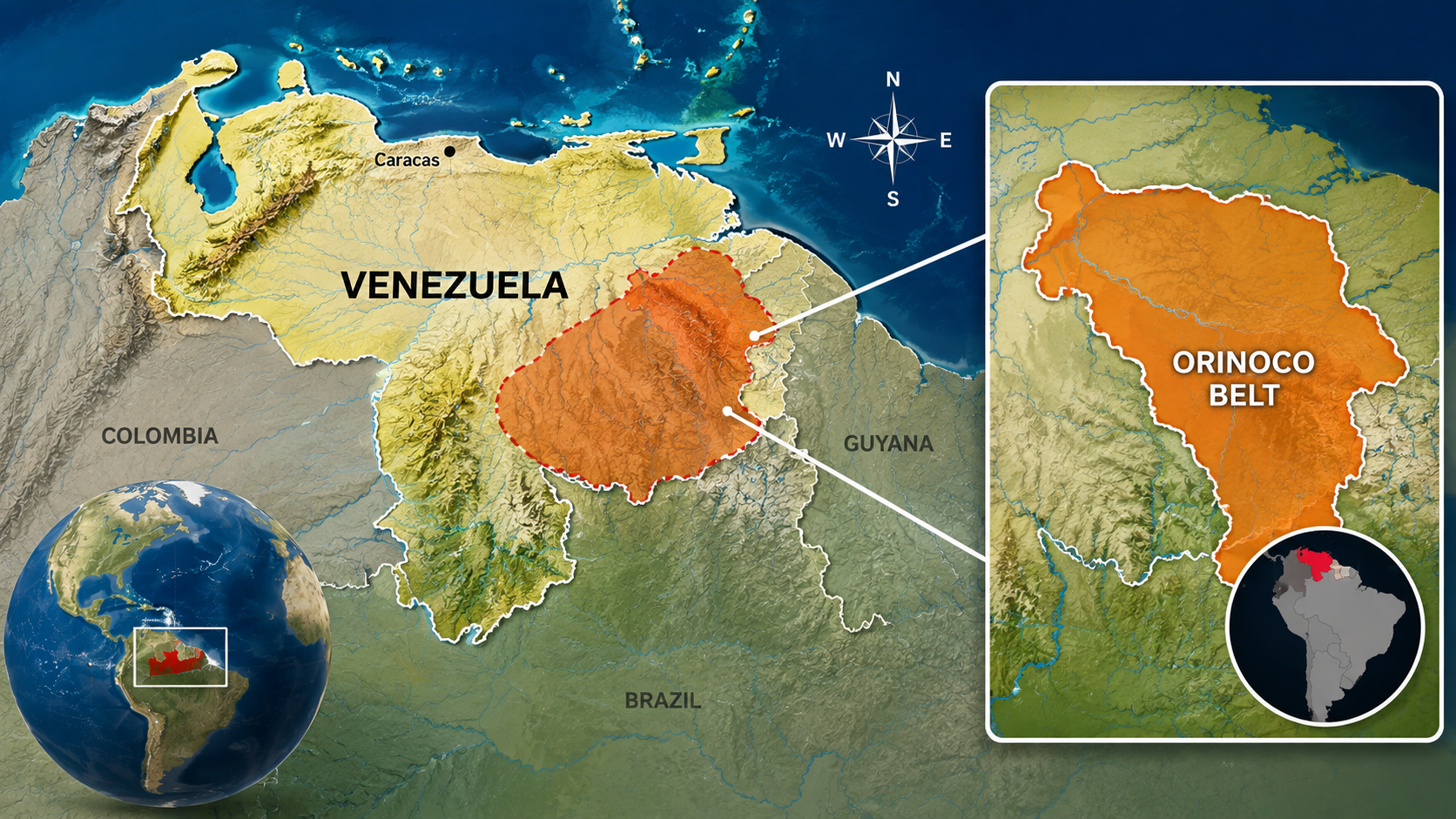
Why is the Orinoco Belt Important?
Its importance arises from:
- Extremely large petroleum deposits
- Venezuela’s position as the world’s largest holder of proven oil reserves
- Heavy and extra-heavy crude resources
- Strategic importance for Venezuela’s petroleum industry
- Potential contribution to long-term global oil supply
The development of the Orinoco Belt has therefore remained central to Venezuela’s energy strategy.
What is an Oil Concession?
An oil concession is a legal arrangement through which a government grants a company or group of companies rights to explore, develop, produce and/or market petroleum within a specified area. A concession generally establishes:
- Geographic area covered
- Duration of the rights
- Exploration rights
- Production rights
- Financial obligations
- Government participation
- Ownership and control arrangements
- Regulatory requirements
The proposed arrangement discussed in the article involves a reported 100-year concession, making the duration a particularly notable feature. A very long concession period can provide investors with a longer horizon for recovering the substantial capital required for oil exploration, production and infrastructure.
Joint Venture in the Petroleum Sector
A joint venture (JV) is a business arrangement in which two or more parties cooperate through a shared corporate or contractual structure. In the petroleum industry, joint ventures can combine:
Government/state participation + Private capital + Technology + Infrastructure + Operational expertise
The precise division of ownership, control, investment and profits depends on the agreement. In the reported U.S.–Venezuela arrangement, the private joint venture is associated with the proposed development of oil reserves and a reported 55% U.S. majority stake.
What Does a 55% Majority Stake Mean?
A majority stake means holding more than half of the ownership interest in a company or joint venture. A reported 55% stake would therefore provide majority ownership to the U.S.-linked side of the arrangement, subject to the precise contractual and corporate structure.
- 55% majority equity stake
- Access to oil at cost
- Participation through a private joint venture
- Long-term concession rights
The combination is significant because ownership, operational control and access to production can be structured differently in petroleum agreements.
Oil at Cost: What Does it Mean?
The reported arrangement also includes access to oil at cost. In a broad commercial sense, access to oil at cost means that the participating party obtains petroleum based on the relevant production or associated cost structure rather than purchasing it at the prevailing open-market price. The economic effect depends on how “cost” is defined contractually, including which production, transportation, processing and other expenses are included.
Therefore, equity ownership and access to oil at cost are distinct mechanisms through which an investor or participating entity may obtain economic benefits from an oil project.
United States and Venezuela: Energy Significance
Venezuela is one of the world’s most petroleum-rich countries, while the United States is one of the world’s largest energy consumers and has a highly developed petroleum industry. A major investment or production arrangement involving Venezuelan oil can therefore have implications for:
- Oil production
- Investment flows
- Energy security
- Refining supply
- Global petroleum markets
- Bilateral economic relations
- Long-term energy planning
The significance is amplified by the sheer size of Venezuela’s petroleum reserves.
Strategic Petroleum Reserve of the United States
The U.S. Strategic Petroleum Reserve (SPR) is the world’s largest emergency stockpile of crude oil. It was established following the 1973 oil crisis and was created under the Energy Policy and Conservation Act, 1975. The reserve is primarily intended to provide a strategic buffer against severe disruptions in petroleum supplies.
Storage of the Strategic Petroleum Reserve
Unlike conventional above-ground oil storage tanks, the U.S. SPR is stored mainly in underground salt caverns along the Gulf Coast. Salt formations are suitable for large-scale underground petroleum storage because appropriately engineered salt caverns can provide secure containment.
Why Does the SPR Matter?
The Strategic Petroleum Reserve can be used during major supply disruptions to:
- Cushion interruptions in crude supply
- Support emergency energy requirements
- Reduce the impact of severe petroleum shortages
- Provide additional flexibility to the U.S. energy system
It is therefore an important component of U.S. energy security policy.
Strategic Petroleum Reserve vs Venezuelan Oil Reserves
The two concepts should not be confused.
| Feature | Venezuelan Oil Reserves | U.S. Strategic Petroleum Reserve |
|---|---|---|
| Nature | Naturally occurring petroleum reserves | Government-controlled emergency stockpile |
| Location | Primarily within Venezuelan geological formations | Underground salt caverns in the United States |
| Purpose | Potential commercial production | Emergency supply buffer |
| Scale | More than 300 billion barrels of proven reserves in standard estimates | Much smaller than Venezuela’s total geological reserves |
| Strategic role | Long-term petroleum production potential | Short-term energy supply security |
The Venezuelan reserves represent petroleum resources that can potentially be produced, whereas the SPR represents already-stocked crude oil intended for emergency use.
Venezuela and OPEC
Venezuela is a founding member of the Organization of the Petroleum Exporting Countries (OPEC). OPEC was established in 1960. The organisation was created to coordinate and unify petroleum policies among member countries and promote stability in international oil markets. Venezuela’s enormous reserves give it particular significance within the global petroleum system.
Importance of the US–Venezuela Oil Agreement 2026 for Energy Security
The reported agreement comes against the background of continued global attention to:
- Energy security
- Diversification of oil supply
- Long-term petroleum investments
- Geopolitical risks affecting energy markets
- Access to large hydrocarbon reserves
Developing Venezuelan oil reserves could potentially increase production capacity over the long term, although the actual impact would depend on investment, infrastructure, technology, production economics and the terms governing the concession.
US–Venezuela Oil Agreement 2026: Important Facts for Exams
- Agreement announced: 28 August 2026
- Countries involved: United States and Venezuela
- Oil reserves involved: More than 65 billion barrels
- Venezuela’s total proven reserves: More than 300 billion barrels in many standard reference estimates
- Major petroleum region: Orinoco Belt
- Reported U.S. stake: 55%
- Reported concession period: 100 years
- Structure: Private joint venture
- Venezuela: Member and founding member of OPEC
- OPEC founded: 1960
- U.S. Strategic Petroleum Reserve: World’s largest emergency crude oil stockpile
- SPR established: 1975
- Legal basis: Energy Policy and Conservation Act, 1975
- SPR storage: Underground salt caverns along the U.S. Gulf Coast
- 1973 oil crisis: Major historical event behind creation of the SPR
