

Industries of the world
Industries of the World: Industries form the backbone of the modern world. Farms feed billions. Factories power economies. Digital platforms are reshaping daily life. Every nation’s growth story is deeply linked to how its industries evolve, adapt, and compete in an interconnected global marketplace.
The industries of the world reflect humanity’s journey from manual labour to mechanisation, and now to automation and artificial intelligence. Agriculture, manufacturing, mining, energy, services, and high-technology sectors drive economic output. They also influence employment patterns, trade relations, urbanisation, and environmental sustainability. Together, they reveal how societies organise production, distribute resources, and respond to changing consumer needs.
In this Article, we explore major global industries, their geographical distribution, historical evolution, and contemporary trends. The discussion highlights how different regions specialize. It covers traditional industries like textiles and steel. It also includes emerging sectors such as renewable energy, biotechnology, and digital services.
‘Industries of the World’ is one of the most important topic for UPSC/ UPPSC and other competitive exams. Many questions are being asked every year repeatedly. Thus, it becomes important for the aspirants to cover this topic thoroughly. So that, no question is missed in the exam.
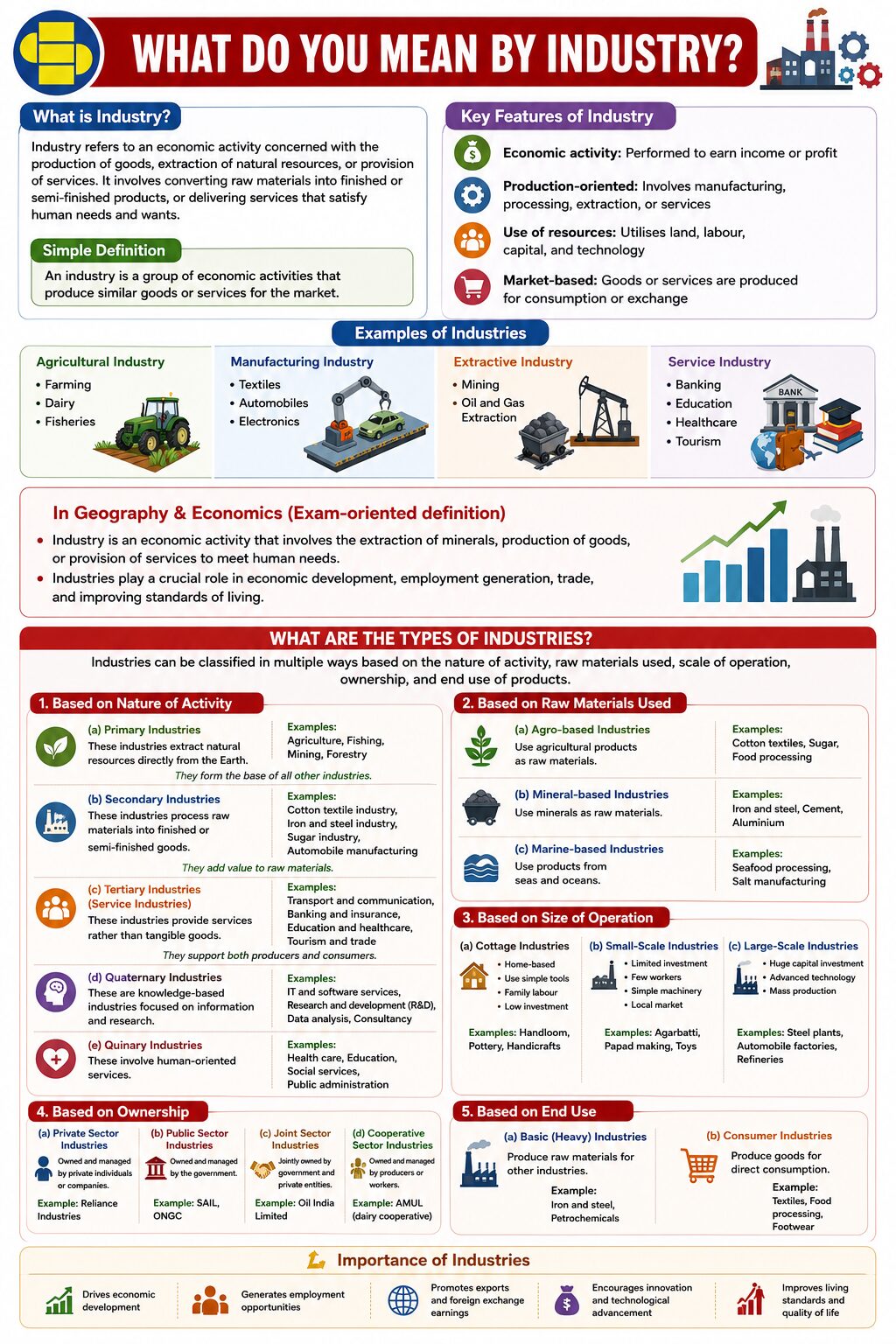
What do you mean by Industry?
Industry refers to an economic activity concerned with the production of goods, extraction of natural resources, or provision of services. It involves converting raw materials into finished or semi-finished products, or delivering services that satisfy human needs and wants.
Simple Definition
An industry is a group of economic activities that produce similar goods or services for the market.
Key Features of Industry
- Economic activity: Performed to earn income or profit
- Production-oriented: Involves manufacturing, processing, extraction, or services
- Use of resources: Utilises land, labour, capital, and technology
- Market-based: Goods or services are produced for consumption or exchange
Examples of Industries:
- Agricultural industry: Farming, dairy, fisheries
- Manufacturing industry: Textiles, automobiles, electronics
- Extractive industry: Mining, oil and gas extraction
- Service industry: Banking, education, healthcare, tourism
In Geography & Economics (Exam-oriented definition)
Industry is an economic activity that involves the extraction of minerals, production of goods, or provision of services to meet human needs.
Industries play a crucial role in economic development, employment generation, trade, and improving standards of living.
What are the types of Industries?
Industries can be classified in multiple ways based on the nature of activity, raw materials used, scale of operation, ownership, and end use of products. This classification is important for Geography, Economics, and UPSC/State PSC exams.
1. Types of Industries Based on Nature of Activity
(a) Primary Industries
These industries extract natural resources directly from the Earth.
Examples:
- Agriculture
- Fishing
- Mining
- Forestry
👉 They form the base of all other industries.
(b) Secondary Industries
These industries process raw materials into finished or semi-finished goods.
Examples:
- Cotton textile industry
- Iron and steel industry
- Sugar industry
- Automobile manufacturing
👉 They add value to raw materials.
(c) Tertiary Industries (Service Industries)
These industries provide services rather than tangible goods.
Examples:
- Transport and communication
- Banking and insurance
- Education and healthcare
- Tourism and trade
👉 They support both producers and consumers.
(d) Quaternary Industries
These are knowledge-based industries focused on information and research.
Examples:
- IT and software services
- Research and development (R&D)
- Data analysis
- Consultancy
(e) Quinary Industries
These involve human-oriented services.
Examples:
- Health care
- Education
- Social services
- Public administration
2. Types of Industries Based on Raw Materials Used
(a) Agro-based Industries
Use agricultural products as raw materials.
Examples: Cotton textiles, sugar, food processing
(b) Mineral-based Industries
Use minerals as raw materials.
Examples: Iron and steel, cement, aluminium
(c) Marine-based Industries
Use products from seas and oceans.
3. Types of Industries Based on Size of Operation
(a) Cottage Industries
- Home-based
- Use simple tools
- Family labour
(c) Large-Scale Industries
- Huge capital investment
- Advanced technology
- Mass production
Examples: Steel plants, automobile factories, refineries
4. Types of Industries Based on Ownership
(a) Private Sector Industries
(c) Joint Sector Industries
Jointly owned by government and private entities.
Example: Oil India Limited
(d) Cooperative Sector Industries
Owned and managed by producers or workers.
Example: AMUL (dairy cooperative)
5. Types of Industries Based on End Use
(a) Basic (Heavy) Industries
Produce raw materials for other industries.
Example: Iron and steel, petrochemicals
(b) Consumer Industries
Produce goods for direct consumption.
Example: Sugar, paper, electronics


Concentration of Manufacturing Industries
| Key Point | Details |
| Definition | Industrial regions = zones of manufacturing concentration due to favourable geopolitical & economic factors |
| Distribution | Uneven worldwide, based on resources & infrastructure |
| Localization trend | Industries cluster in regions with multiple locational advantages |
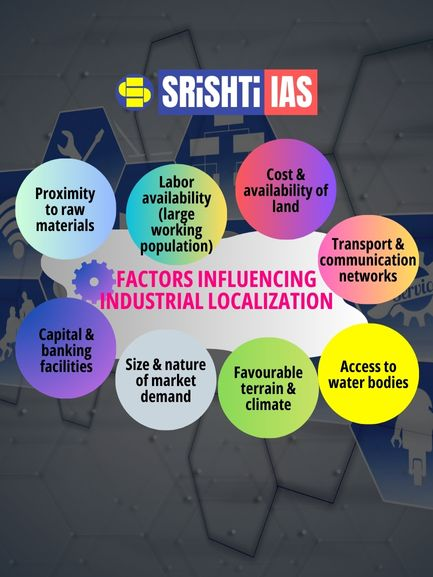
Factors Influencing Industrial Localization
- Size & nature of market demand
- Labor availability (large working population)
- Cost & availability of land
- Proximity to raw materials
- Transport & communication networks
- Access to water bodies
- Capital & banking facilities
- Favourable terrain & climate
Historical Background of the Development of Industries
The development of modern industries is closely linked with the Industrial Revolution. This was a transformative phase in human history. It marked the shift from agrarian, handicraft-based economies to machine-driven industrial production. This revolutionary change began in Britain in the mid-18th century, earning it recognition as the birthplace of the Industrial Revolution.
Before industrialisation, production was largely carried out through the domestic or cottage system, where goods were handmade using simple tools. Britain, however, possessed a unique combination of favourable conditions that accelerated industrial growth. Among these were abundant coal and iron ore. They provided cheap energy and raw materials. Additionally, Britain had a stable political system. It also had a well-developed banking and credit structure. This structure supported investment in new technologies.
A major catalyst was the Agricultural Revolution, which improved farming techniques and productivity. This led to surplus food, population growth, and the availability of labour for factories. At the same time, Britain’s vast colonial empire provided steady access to raw materials. It also offered large overseas markets for finished goods.
Technological innovations played a decisive role. Inventions such as James Watt’s improved steam engine, Hargreaves’ spinning jenny, and Cartwright’s power loom had a major impact. They revolutionised textile manufacturing. This was particularly true for the cotton industry. These inventions promoted the factory system, where machines replaced manual labour, and production became faster, cheaper, and more efficient.
The success of industrialisation in Britain soon spread to other parts of Europe and North America, reshaping global economic structures. Britain’s early industrial development transformed its own society. It laid the foundation for modern industrial economies worldwide.
- Cottage Industries → Industrial Revolution
- Small-scale, local production → mass production
- Economies of scale → reduced costs
- Profit maximization via higher output
Britain as the Birthplace of the Industrial Revolution
- Started in Northern England (18th century)
- Liverpool – imported cotton from America & India
- Factories near coal fields, connected to ports via rivers/canals
- Railroads & steamships → reduced transport costs → global dominance
Diffusion of Industrialization
| Region | Key Features |
| Eastern North America | Coal proximity, port access, capital investment |
| Western Russia & Ukraine | Rich coal resources, waterways |
| East Asia | Coastal industrial hubs |
Common traits:
- Coal deposits nearby
- Rail/water port access
- Capital inflows (Europe + locals)
Globalization & Shifting of Industries
Nature of Globalization
- Flows of information, goods, ideas, culture, capital, people
- Dimensions:
- Economic globalization
- World opinion formation
- Democratization
- Political globalization
Effects on Economy
- Shift from self-sufficiency → global interdependence
- Trade = backbone of globalization
- Faster flows due to Industrial Revolution tech + modern transport
Industrial Restructuring (Post-1980s)
From Fordism → Post-Fordism
| Fordism | Post-Fordism |
| Mass production | Flexible production |
| Standardized goods | Customized goods |
| Centralized manufacturing | Global production networks |
| Assembly line | Just-in-time assembly |
| Higher wages → mass consumption | Contractual, part-time, outsourced work |
Technological Enablers
- Production tech: automation, robotics
- Transaction tech: computer-based management
- Circulation tech: internet, satellite
Deindustrialization & Reindustrialization
- Deindustrialization: Decline in traditional manufacturing (job losses, slowdown)
- Reindustrialization: Rise of new industries (often high-tech) in new/old areas
Economic Sectors
- Primary – extraction (agriculture, mining)
- Secondary – manufacturing
- Tertiary – services (trade, banking, education)
Outsourcing, Offshoring & FDI
Outsourcing – Hiring external firms
Offshoring – Relocating production abroad
BPO – Customer service, accounting, data processing
TNCs (Transnational Corporations)
- Operate across borders
- Drive FDI (factories, R&D abroad)
Top FDI Sources – USA, EU, Hong Kong, Japan
Top FDI Destinations – Hong Kong, China, Singapore, Mexico, Brazil, India
New Industrial Regions
Rise of the Pacific Rim
- Lower labour costs
- Favourable legal systems
- Skilled/semi-skilled workforce
The Four Asian Tigers
| Country | Key Traits |
| South Korea | Shift from agrarian to high-tech (autos, electronics) |
| Taiwan | State-led high-tech promotion |
| Hong Kong | Port & finance hub, gateway to China |
| Singapore | Strategic entrepôt → high-tech + services hub |
China’s Transformation into Global Industrial Hub
- Opened to foreign trade in 1978
- Northeast district – heavy industry (coal, iron)
- Shanghai–Chang Jiang – major manufacturing
- East & South provinces – dynamic manufacturing belts
Other NICs
- South Africa – industry & mining
- Brazil, Russia, India – rising global powers
India’s Industrial Zones
| Zone | Centre | Industries |
| Eastern | Kolkata | Engineering, chemicals, textiles, steel |
| Western | Mumbai | Cotton textiles, chemicals, hydroelectric power |
| Southern | Chennai | Light engineering, textiles |
Strengths
- Large domestic market
- Skilled yet cost-effective labor
- IT hub (Bangalore)
- Strategic central location
Major Industrial Regions of the World (List- Region-wise)
| Region | Sub-region / Major Centres | Key Industries |
| Eastern North America | Great Lakes (Chicago, Detroit, Indian Harbour) | Iron & steel, engineering, automobiles, meatpacking |
| Appalachian Region | Iron & steel, engineering | |
| New England | Fisheries, cotton textiles, iron & steel | |
| Western & Central Europe | Rhine Valley (Ruhr, Germany) | Coal mining, steel, chemicals, automobiles, ships |
| UK (North East Coast) | Mixed industries near coalfields | |
| Lorraine (France) | Iron & steel, crystal | |
| Southern Poland / Northern Czech Republic | Heavy industry | |
| Eastern Europe | Moscow-Tula | Iron-steel, heavy chemicals, metallurgy, machine tools, refineries, textiles, automobiles |
| Southern Ukraine | Iron, steel, metallurgy | |
| Ural Industrial Region | Machine tools, agricultural machinery, chemicals | |
| Kuznetsk | Coal, iron & steel | |
| Eastern Asia | Japan (Yokohama) | Shipping, biotechnology, semiconductors |
| China (Manchuria) | Coal, iron & steel, aluminium, machinery, locomotives, aircraft, chemicals | |
| India (Calcutta Conurbation) | Jute, cotton textiles, chemicals, pharmaceuticals, engineering, automobiles |
Industrial Cities & Their Major Industries (List City-wise)
| Country | City | Major Industries |
| China | Shanghai | Steel, automotive, petrochemicals, electronics, biotechnology, IT |
| Shenzhen | Electronics, telecom, computer hardware | |
| Guangzhou | Textiles, automobiles | |
| Qingdao | Petrochemicals, metallurgy, textiles | |
| Dongguan | Electronics | |
| Suzhou | Electronics, IT, clothing | |
| India | Mumbai | Cotton textiles, engineering, chemicals, food processing, pharmaceuticals, film |
| Bengaluru | Software, IT | |
| Chennai | Leather goods, rail coaches | |
| Jamshedpur | Steel | |
| Ahmedabad | Cotton textiles | |
| Japan | Tokyo-Yokohama | Metals, chemicals, machinery, electronics |
| Osaka | Cotton textiles, machinery, shipbuilding | |
| South Korea | Ulsan | Shipbuilding, steel, oil & gas |
| Pohang | Steel | |
| Changwon | Defense, machinery, automobiles | |
| Taiwan | Taipei | Electronics, computer hardware |
| Thailand | Bangkok | Automotive parts |
| Vietnam | Ho Chi Minh City | Footwear, furniture |
| Bangladesh | Dhaka | Textiles, garments |
| Indonesia | Surabaya | Furniture, handicrafts |
| Malaysia | Penang | Semiconductors, electronics |
| Germany | Ruhr | Steel, chemicals, automobiles |
| Stuttgart | Automotive | |
| Munich | Technology, automotive | |
| Hamburg | Shipping, logistics | |
| UK | Manchester | Textiles, advanced manufacturing |
| Birmingham | Automotive | |
| Sheffield | Steel | |
| Glasgow | Shipbuilding, chemicals | |
| Russia | Moscow-Tula | Steel, chemicals, automobiles |
| Ural | Machinery, chemicals | |
| Norilsk | Palladium, nickel | |
| France | Paris | Perfumes, food |
| Toulouse | Aviation | |
| Italy | Milan | Fashion, textiles |
| Turin | Automotive | |
| Lecco | Industrial manufacturing | |
| USA | Chicago | Meatpacking, agricultural machinery |
| Detroit | Automobiles | |
| Pittsburgh | Steel | |
| Los Angeles | Aerospace, film | |
| San Francisco | Technology | |
| Seattle | Aerospace | |
| Canada | Montreal, Ottawa, Toronto | Textiles, engineering, paper |
| Brazil | São Paulo | Automobiles, steel, petrochemicals |
| Rio de Janeiro | Shipbuilding, oil & gas | |
| Minas Gerais | Iron ore, steel | |
| São José dos Campos | Aviation | |
| Porto Real | Automotive | |
| Argentina | Buenos Aires | Dairy, meat |
| Ecuador | Guayaquil | Port-based industries |
| South Africa | Johannesburg | Multisector industries |
| Cape Town | Mixed industries | |
| Durban | Manufacturing | |
| Nigeria | Lagos | Consumer goods, finance |
| Egypt | Cairo | Tourism, oil, healthcare |
| Morocco | Casablanca | Finance, shipping |
| Kenya | Nairobi | Agribusiness, manufacturing |
| Ghana | Accra | Port-based industries |
| Australia | Newcastle | Mining |
| Coolgardie | Gold mining | |
| Sydney | Finance, mixed industries |
