

India’s Free Trade Agreements- Analysis
Why in News?
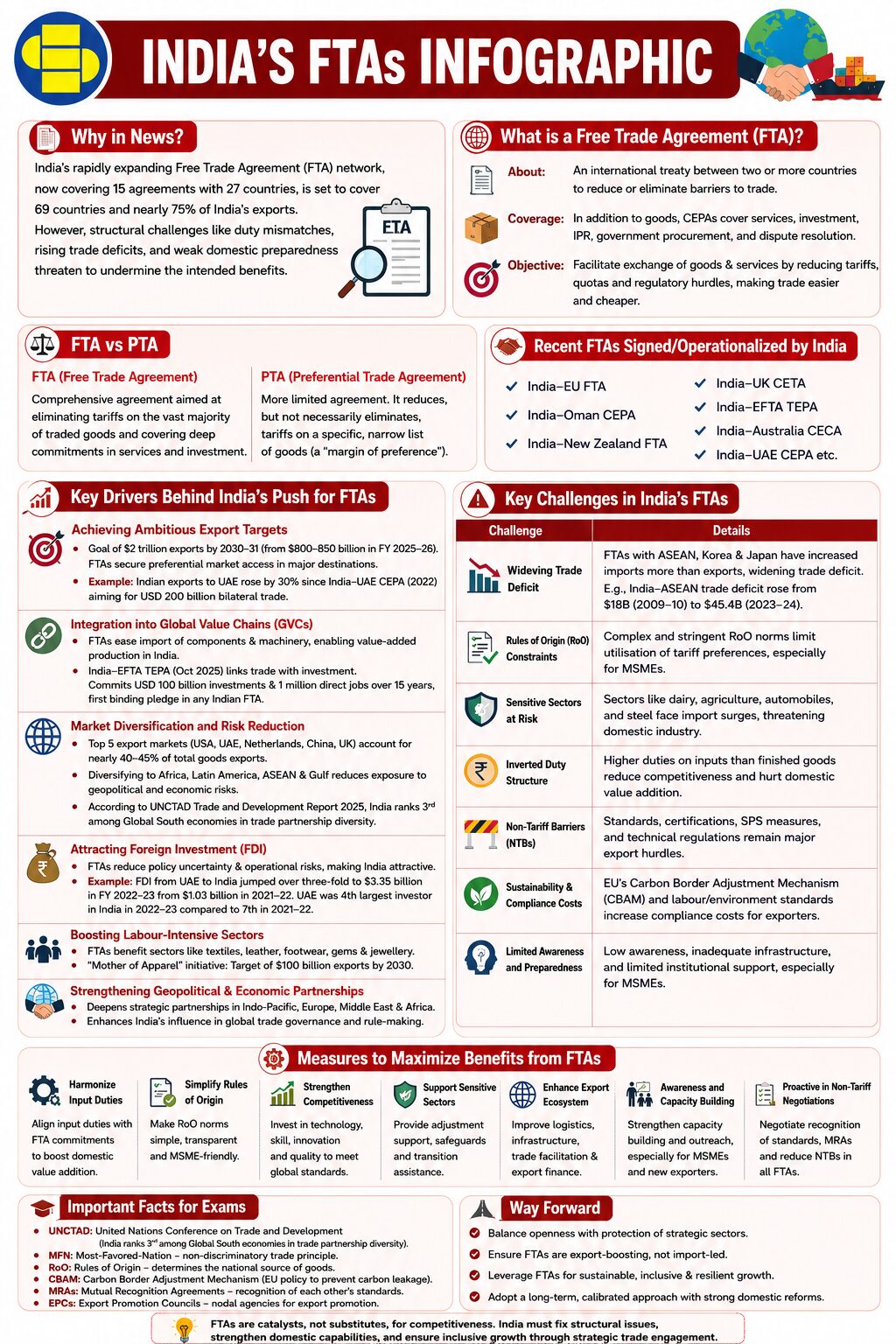
India is aggressively expanding its Free Trade Agreement (FTA) network. Currently, India has 15 operational FTAs covering 27 countries, while negotiations on 9 additional agreements involving 42 countries are nearing completion. Once finalized, India’s FTA partners will account for nearly 75% of India’s exports and represent a significant share of global economic activity.
However, concerns are growing that India’s FTAs have often resulted in rising imports, widening trade deficits, low utilization rates by exporters, and pressure on domestic manufacturing. These developments have triggered a debate on whether FTAs are delivering their intended benefits.
What is a Free Trade Agreement (FTA)?
A Free Trade Agreement (FTA) is an international treaty between two or more countries aimed at reducing or eliminating barriers to trade.
Key Features of Free Trade Agreements:
- Reduction or elimination of customs duties.
- Removal of quantitative restrictions.
- Facilitation of trade in goods and services.
- Promotion of investment flows.
- Cooperation in intellectual property rights (IPR).
- Dispute settlement mechanisms.
Modern agreements such as Comprehensive Economic Partnership Agreements (CEPAs) and Comprehensive Economic Cooperation Agreements (CECAs) go beyond tariff reductions and include services, digital trade, investment, government procurement, and regulatory cooperation.
India’s Expanding FTA Landscape
Major Recent FTAs
| Agreement | Partner |
|---|---|
| CEPA | UAE |
| TEPA | EFTA Countries |
| CETA | United Kingdom |
| CECA | Australia |
| Proposed FTA | European Union |
| Proposed CEPA | Oman |
| Proposed FTA | New Zealand |
These agreements are central to India’s export-led growth strategy and integration into global supply chains.
Why is India Aggressively Pursuing FTAs?
1. Achieving Ambitious Export Targets
India aims to achieve $2 trillion in merchandise and services exports by 2030-31, up from approximately $800-850 billion in FY 2025-26.
FTAs provide:
- Preferential market access.
- Lower tariffs.
- Improved competitiveness for Indian exporters.
Example
Since the implementation of the India-UAE CEPA, Indian exports to the UAE have reportedly increased significantly, supporting the long-term objective of achieving $200 billion bilateral trade.
2. Integration into Global Value Chains (GVCs)
Modern manufacturing depends on cross-border production networks.
FTAs help:
- Import intermediate goods at lower costs.
- Attract multinational companies.
- Encourage value-added manufacturing in India.
Example
The India-EFTA TEPA includes a commitment of $100 billion investment over 15 years and the creation of around 1 million jobs, making it one of India’s most ambitious trade-linked investment arrangements.
3. Diversification of Export Markets
India’s exports remain concentrated in a few major destinations.
Top Markets:
- United States
- UAE
- Netherlands
- China
- United Kingdom
Together they account for nearly 40-45% of India’s exports. Excessive dependence creates vulnerabilities arising from geopolitical tensions, protectionism, and economic downturns.
FTAs allow India to expand into:
- Africa
- Latin America
- Gulf Countries
- ASEAN
- Europe
4. Attracting Foreign Direct Investment (FDI)
FTAs enhance investor confidence by providing:
- Predictable market access.
- Stable trade rules.
- Lower business uncertainty.
Example
FDI inflows from the UAE increased sharply after the signing of CEPA, highlighting the investment-enhancing role of trade agreements.
5. Supporting Labour-Intensive Industries
India seeks to boost sectors such as:
- Textiles
- Apparel
- Footwear
- Leather
- Gems and Jewellery
These sectors generate large-scale employment and can significantly benefit from duty-free access to developed markets.
6. Strategic and Geopolitical Objectives
Trade agreements increasingly serve strategic purposes.
FTAs help India:
- Strengthen partnerships with trusted economies.
- Reduce dependence on specific regions.
- Enhance influence in global trade governance.
- Position itself as a reliable alternative manufacturing destination under the “China Plus One” strategy.
Key Challenges in India’s FTAs
1. Rising Trade Deficits
A major criticism is that imports have increased faster than exports.
Examples
India’s trade deficits with:
- ASEAN
- Japan
- South Korea
have grown substantially after implementation of trade agreements.
This raises concerns that FTAs may be creating import dependence rather than export competitiveness.
2. Low FTA Utilization Rates
An FTA creates opportunities only when exporters use its benefits.
India’s utilization rate remains relatively low because of:
- Complex paperwork.
- Limited awareness.
- Difficult Rules of Origin (RoO) requirements.
While developed economies often record utilization rates of 70-80%, Indian utilization levels remain significantly lower.
3. Rules of Origin (RoO) Constraints
Rules of Origin determine the national source of a product.
Problems include:
- Complex documentation requirements.
- Compliance costs for MSMEs.
- Delays in certification.
Many firms prefer paying normal duties rather than navigating complicated RoO procedures.
4. Inverted Duty Structure
India often imposes higher tariffs on raw materials than on finished goods imported under FTAs.
Consequences
- Reduced domestic value addition.
- Competitive disadvantage for Indian manufacturers.
- Incentive to import finished products instead of producing locally.
This challenge is particularly visible in:
- Engineering products.
- Chemicals.
- Plastics.
- Textiles.
- Electronics.
5. Emerging Non-Tariff Barriers (NTBs)
Tariffs are declining globally, but regulatory barriers are increasing.
Examples
- Carbon Border Adjustment Mechanism (CBAM).
- Environmental standards.
- Labour standards.
- Food safety requirements.
- Technical regulations.
Indian MSMEs often struggle to comply with these standards, limiting the benefits of market access.
6. Limited Integration into Global Value Chains
India’s participation in GVCs remains relatively low compared to competitors.
| Country | Foreign Value Added Content in Exports |
| Vietnam | 43.6% |
| OECD Average | 19.3% |
| India | 16.1% |
This indicates that India is yet to become a major node in global production networks.
What Should India Do?
Build a National Export Compliance Ecosystem
India should create a digital compliance platform that helps exporters understand:
- Product standards.
- Packaging norms.
- Environmental requirements.
- Certification processes.
Strengthen MSME Testing Infrastructure
Regional testing and certification hubs can help MSMEs obtain internationally recognized certifications at lower costs.
Link PLI Schemes with Export Performance
Production-Linked Incentive (PLI) schemes should be aligned with FTA opportunities to ensure that domestic manufacturing translates into export growth.
Simplify Rules of Origin
India should negotiate:
- Simpler documentation requirements.
- Digitized certification systems.
- Sector-specific RoO reforms.
Improve Trade Logistics
The success of FTAs depends on:
- Efficient ports.
- Faster customs clearance.
- Lower logistics costs.
- Better supply-chain connectivity.
Initiatives such as:
- PM Gati Shakti
- National Logistics Policy
can support this objective.
Expand Mutual Recognition Agreements (MRAs)
MRAs can reduce duplication of testing and certification requirements between trading partners, lowering costs for exporters.
Conclusion
India’s expanding FTA network represents a major shift in its trade strategy and offers enormous opportunities for exports, investment, and integration into global supply chains. However, rising trade deficits, low utilization rates, inverted duty structures, and growing non-tariff barriers reveal significant structural weaknesses.
The success of India’s FTA strategy will ultimately depend not merely on signing agreements but on strengthening domestic competitiveness, improving export readiness, supporting MSMEs, and ensuring that trade liberalization translates into sustainable economic growth. FTAs should become instruments of export-led industrialization rather than gateways for import dependence.

Good