

Romania
Romania is a country in Southeastern Europe, situated at the crossroads of Central, Eastern and Southeastern Europe. Its geography is dominated by the Carpathian Mountains, Transylvanian Plateau, Danube River, fertile plains and the Black Sea coast. Romania has considerable geopolitical importance due to its location near Ukraine and Moldova, access to the Black Sea, and membership in both the European Union (EU) and North Atlantic Treaty Organization (NATO). Its capital, Bucharest, is the country’s largest city and its main political, economic and cultural centre.
Romania at a Glance
- Capital: Bucharest
- Official Language: Romanian
- Currency: Romanian Leu (RON)
- Location: Southeastern Europe
- Major River: Danube
- Major Mountain Range: Carpathian Mountains
- Highest Peak: Moldoveanu Peak – 2,544 metres
- Major Plateau: Transylvanian Plateau
- Major Port: Constanța
- Sea: Black Sea
- Government: Semi-presidential republic
- Legislature: Bicameral Parliament
- EU Member: Since 2007
- NATO Member: Since 2004
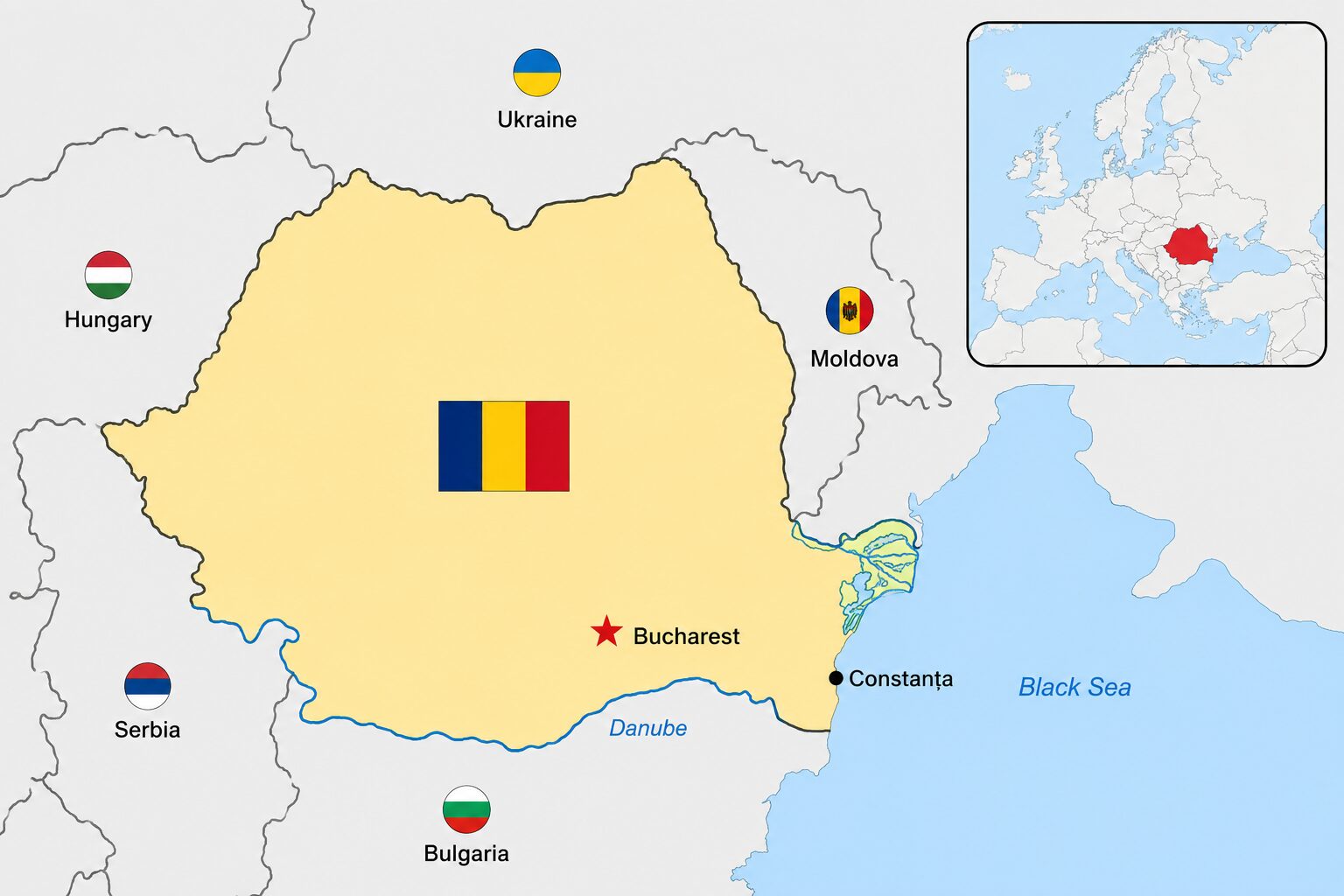
Geography and Location of Romania
Romania occupies an area of approximately 238,000 sq. km. Its geographical position gives it access to important European land and maritime routes. The country is organised around three major physical features: the Carpathian mountain arc, the Danube River system, and the surrounding plains and plateaus. The Carpathians curve through central Romania, while the Danube flows along much of its southern boundary before entering the Black Sea through the ecologically important Danube Delta.
Neighbouring Countries of Romania
Romania shares land borders with five countries:
- Ukraine – north and northeast
- Moldova – northeast and east
- Bulgaria – south
- Serbia – southwest
- Hungary – west and northwest
The Black Sea lies to the southeast. This location makes Romania an important geographical bridge between Central Europe, Eastern Europe, the Balkans and the Black Sea region.
Major Physical Divisions of Romania
Romania’s relief is remarkably balanced. Mountains occupy the central region, while hills, plateaus and plains surround them.
Carpathian Mountains
The Carpathian Mountains are Romania’s most prominent physical feature. They form a broad arc through the centre of the country and are part of the larger European Carpathian mountain system. The Romanian Carpathians are divided into three major sections:
- Eastern Carpathians
- Southern Carpathians
- Western Romanian Carpathians
The Southern Carpathians, also known as the Transylvanian Alps, contain Romania’s highest mountains.
Moldoveanu Peak
Moldoveanu Peak, located in the Făgăraș Mountains of the Southern Carpathians, is Romania’s highest point at approximately 2,544 metres. The nearby Negoiu Peak is another important high-altitude peak. The Carpathians influence Romania’s climate, river drainage, forests, biodiversity and settlement patterns.
Transylvanian Plateau
The Transylvanian Plateau lies in central Romania and is almost enclosed by the Carpathian arc. The plateau consists mainly of rolling hills, valleys and agricultural landscapes. Transylvania is also an important historical and cultural region of Romania. Its natural enclosure by mountains gives it a distinct geographical identity.
Romanian Plain
The Romanian Plain, or Wallachian Plain, lies south of the Carpathians and extends towards the Danube. Its fertile soils make it one of Romania’s most important agricultural regions.
Major crops include:
- Wheat
- Maize
- Sunflower
- Oilseeds
- Other commercial crops
Western Plains
Western Romania contains lowlands associated with the larger Pannonian Basin. These fertile plains extend towards Hungary and Serbia and support agriculture, settlements and major transport corridors.
Major Rivers of Romania
Romania has an extensive river network. Most rivers ultimately drain into the Danube River system.
Danube River
The Danube is Romania’s most important river and the second-longest river in Europe after the Volga. It originates in the Black Forest of Germany and flows across Central and Southeastern Europe before entering the Black Sea. In Romania, the Danube:
- Forms much of the border with Bulgaria.
- Supports inland navigation and international trade.
- Provides water for irrigation and industries.
- Supports hydroelectric power generation.
- Receives several important Romanian tributaries.
- Forms the Danube Delta before reaching the Black Sea.
The Iron Gates region on the Romania-Serbia border is an important gorge and hydroelectric development area along the Danube.
Other Major Rivers
The Mureș River flows through Transylvania and western Romania before entering Hungary. The Olt River originates in the Carpathians, crosses the mountains southward and joins the Danube. It is important for hydroelectricity. The Siret River drains a large part of eastern Romania before joining the Danube. The Prut River forms much of the international boundary between Romania and Moldova. Other important rivers include the Jiu, Argeș, Ialomița and Someș.
Danube Delta
The Danube Delta is one of Romania’s most important geographical and ecological features. It is formed where the Danube divides into distributaries before entering the Black Sea. Most of the delta lies in Romania, while a smaller part extends into Ukraine.
The region contains:
- Marshes
- Reed beds
- Lakes
- Channels
- Islands
- Wetland forests
It is one of Europe’s largest and best-preserved wetland ecosystems. The Danube Delta Biosphere Reserve is part of UNESCO’s World Network of Biosphere Reserves. The Danube Delta is also recognised as a UNESCO World Heritage Site.
It provides habitat for numerous fish and bird species, including large populations of pelicans and migratory waterbirds.
Black Sea Coast and Port of Constanța
Romania has a strategically important coastline along the western Black Sea. Constanța is Romania’s principal maritime port and one of the largest and most important ports in the Black Sea region. It connects maritime trade routes with the Danube basin and Central European transport networks. The Danube-Black Sea Canal provides an important navigation route connecting the Danube with the Black Sea near Constanța. Romania’s Black Sea location is important for:
- Maritime trade
- Energy security
- Regional connectivity
- Naval security
- European geopolitics
Climate and Natural Vegetation
Romania mainly experiences a temperate continental climate, characterised by relatively cold winters and warm summers. Its climate is influenced by continental, Atlantic and Mediterranean air masses. The Carpathian Mountains also create significant regional climatic variations.
Mountain areas experience colder conditions and snowfall, while southeastern areas near the Black Sea are relatively moderated by maritime influences. Romania has extensive forests containing beech, oak, spruce and fir. The Carpathians support important European wildlife populations, including:
- Brown bear
- Grey wolf
- Eurasian lynx
- Chamois
Political System of Romania
Romania is a semi-presidential representative democratic republic. Its present constitutional framework is based on the Constitution of 1991, subsequently amended. Executive authority is shared within the constitutional system between the President and the Government headed by the Prime Minister.
President
The President is the Head of State and is directly elected by citizens. The President’s major constitutional responsibilities relate to:
- Representation of the Romanian state.
- Foreign and security affairs.
- Safeguarding constitutional functioning.
- Nomination of a candidate for Prime Minister according to constitutional procedures.
- National defence responsibilities.
Prime Minister
The Prime Minister is the Head of Government. The Prime Minister leads the government, coordinates ministries and oversees the implementation of domestic and administrative policies.
Parliament of Romania
Romania has a bicameral Parliament consisting of:
- Senate
- Chamber of Deputies
Parliament exercises legislative authority, passes laws, approves the national budget and exercises democratic oversight over the government. Romania is administratively divided into counties, while Bucharest has a special administrative structure divided into sectors.
Economy of Romania
Romania has a diversified market economy integrated with the wider European Union economy. Important sectors include:
- Automobile and auto-component manufacturing
- Information technology
- Machinery and engineering
- Agriculture
- Chemicals
- Pharmaceuticals
- Energy
- Services
Romania has significant agricultural resources because of its fertile plains. It also possesses a diversified energy mix involving natural gas, oil, hydropower, nuclear energy, wind and solar power. Its location near the Black Sea has increased its importance in discussions on European energy security and regional supply chains.
International and Geostrategic Importance
Romania joined NATO in 2004 and the European Union in 2007. It became a full member of the Schengen Area in 2025. Its strategic importance arises from several geographical factors. Romania borders Ukraine and Moldova, giving it a key position on Europe’s eastern flank. Its Black Sea coastline provides maritime access and enhances its importance in regional security. The Danube connects Romania with several Central and Southeastern European economies, while the Port of Constanța serves as a major gateway between European land routes and Black Sea maritime trade. Thus, Romania occupies a strategically important position connecting Central Europe, Eastern Europe, the Balkans and the Black Sea region.
Important Facts for Exams
- Romania is located in Southeastern Europe.
- Capital: Bucharest.
- Currency: Romanian Leu.
- Neighbours: Ukraine, Moldova, Bulgaria, Serbia and Hungary.
- Country borders the Black Sea.
- Major mountain system: Carpathian Mountains.
- Highest point: Moldoveanu Peak – 2,544 metres.
- Major geographical region: Transylvanian Plateau.
- Major river: Danube.
- Danube is Europe’s second-longest river after the Volga.
- Prut River forms much of the Romania-Moldova border.
- Major port: Constanța.
- Danube Delta is a UNESCO World Heritage Site and Biosphere Reserve.
- Political system: Semi-presidential republic.
- Parliament: Senate and Chamber of Deputies.
- Romania joined NATO in 2004 and the EU in 2007.
- Romania became a full Schengen Area member in 2025.
- Romania is strategically important due to the Danube River, Black Sea access and proximity to Ukraine and Moldova.
