

Project Nimbus: Cloud Computing, Artificial Intelligence, and the Ethics of Dual-Use Technology
Why in News?
Project Nimbus has attracted global attention following growing protests by technology activists, human rights groups, and employees of major technology companies. The controversy centers on the role of advanced cloud computing and Artificial Intelligence (AI) technologies provided by Google and Amazon to the Israeli government and concerns regarding their potential use in military and surveillance operations.
The debate has reignited broader discussions on the ethical use of AI, corporate responsibility, digital sovereignty, and the growing intersection of technology and national security.
What is Project Nimbus?
Project Nimbus is a USD 1.2 billion cloud computing agreement signed in 2021 between the Israeli government and two global technology companies:
- Google Cloud Platform (GCP)
- Amazon Web Services (AWS)
The project was launched to modernize Israel’s digital infrastructure by migrating government data, applications, and computing systems to secure cloud-based platforms.
Its primary objective is to create a robust digital ecosystem that supports government operations, public services, data management, and technological innovation while ensuring that critical information remains within Israel’s jurisdiction.
Project Nimbus: Key Technological Features
Project Nimbus provides advanced cloud infrastructure and Artificial Intelligence tools capable of processing large volumes of data efficiently.
Major Capabilities
- High-capacity cloud storage
- Large-scale computing infrastructure
- Machine learning platforms
- Data analytics systems
- Automated image classification
- Facial detection technologies
- Object recognition and tracking
- Natural language processing
- Sentiment analysis applications
These technologies can support a wide range of civilian applications such as healthcare, transportation, education, disaster management, and public administration.
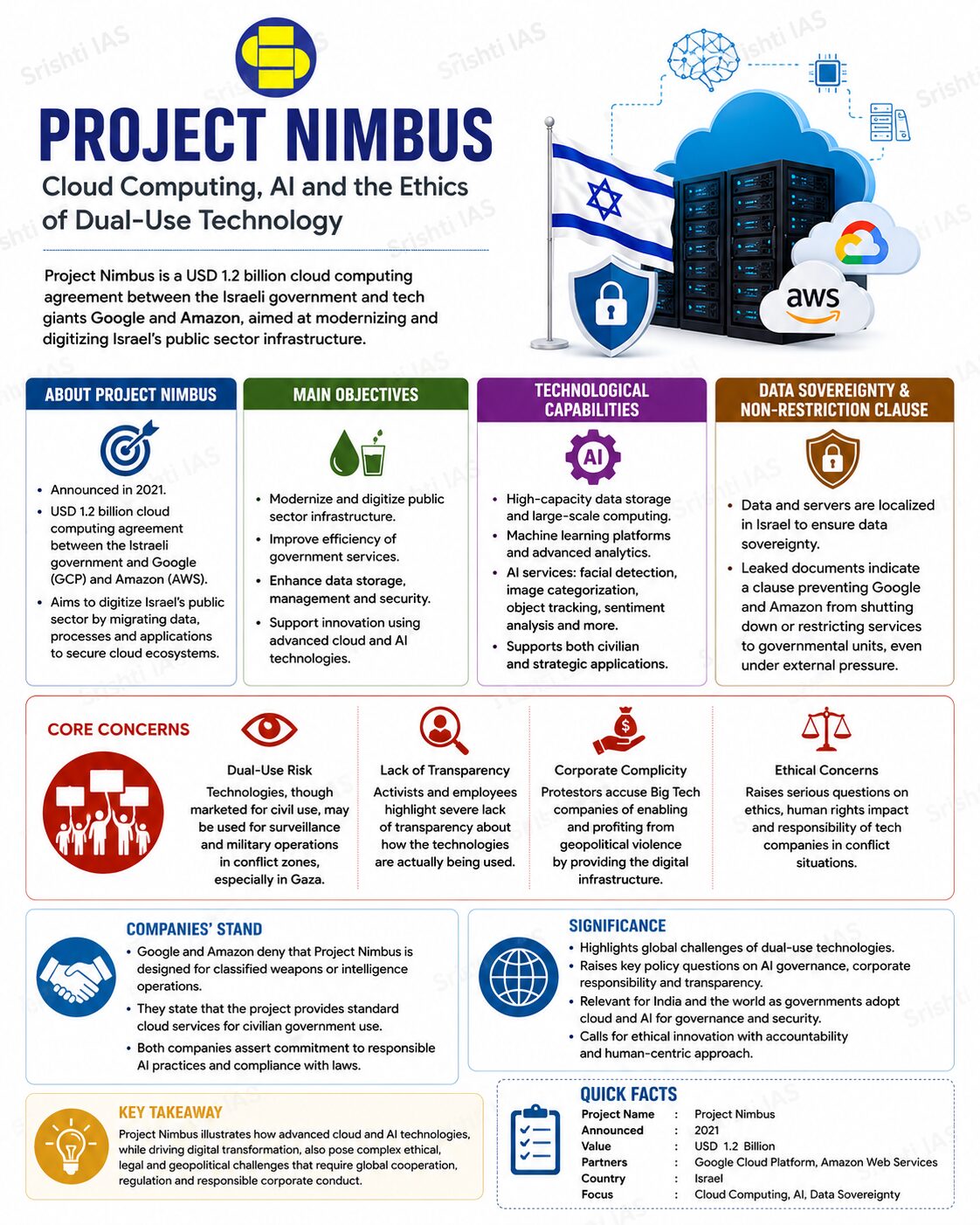
Data Sovereignty and Local Infrastructure
A major feature of Project Nimbus is its emphasis on data sovereignty.
Under the agreement:
- Government data is stored within Israel.
- Cloud infrastructure remains localized.
- Server administration is conducted domestically.
- Sensitive state information remains under Israeli jurisdiction.
Reports based on leaked documents suggest that the contract contains a non-restriction clause, preventing service providers from unilaterally suspending or terminating services to Israeli government entities, even under external political pressure.
This provision is intended to ensure continuity of essential government functions and protect national digital infrastructure from disruptions.
Why is Project Nimbus Controversial?
The controversy surrounding Project Nimbus arises from concerns about the potential military and surveillance applications of AI-enabled technologies.
Critics argue that many of the tools included in the project possess dual-use characteristics, meaning they can serve both civilian and military purposes.
Human rights groups and activists have expressed concerns that technologies such as:
- Facial recognition systems
- Automated image analysis
- Object tracking tools
- Large-scale data processing systems
could potentially be used for surveillance and military operations in conflict zones.
The debate intensified following allegations that cloud infrastructure and AI services might indirectly support activities related to the Israel-Palestine conflict.
Project Nimbus: Position of Google and Amazon
Google and Amazon have rejected allegations that Project Nimbus was designed for classified military operations or weapons systems.
The companies maintain that:
- The project focuses on cloud services for government agencies.
- The contract supports civilian digital infrastructure.
- The technologies provided are standard commercial cloud services.
- The agreement does not involve the development of offensive weapons platforms.
Both companies have emphasized their commitment to responsible AI practices and compliance with applicable laws and regulations.
Dual-Use Technology: A Growing Global Challenge
Project Nimbus highlights a broader challenge facing governments and technology companies worldwide.
Many emerging technologies—including Artificial Intelligence, cloud computing, satellite systems, drones, and quantum technologies—have both civilian and military applications.
This raises important policy questions:
- How should AI be regulated in conflict situations?
- What responsibilities do technology companies have when supplying governments?
- How can transparency and accountability be ensured?
- Where should the line be drawn between commercial services and military applications?
These questions are increasingly shaping international discussions on technology governance and digital ethics.
Importance for India and the World
The debate surrounding Project Nimbus is relevant beyond Israel.
Countries around the world, including India, are rapidly expanding their use of:
- Government cloud infrastructure
- AI-powered governance systems
- Digital public infrastructure
- Defence-related AI applications
As governments adopt advanced technologies for security and administration, balancing innovation with privacy, ethics, and accountability will become increasingly important.
The Project Nimbus controversy serves as an important case study in understanding the opportunities and risks associated with the growing integration of Artificial Intelligence into governance and national security systems.
Project Nimbus: Important Facts for Exams
| Feature | Details |
|---|---|
| Project Name | Project Nimbus |
| Announced | 2021 |
| Value | USD 1.2 Billion |
| Partners | Google Cloud Platform and Amazon Web Services |
| Country | Israel |
| Core Focus | Cloud Computing and AI Infrastructure |
| Key Technologies | Machine Learning, Facial Detection, Image Analysis, Data Analytics |
| Major Concern | Potential dual-use military and surveillance applications |
| Data Storage | Localized within Israel |
| Related Concepts | Artificial Intelligence, Cloud Computing, Digital Sovereignty, Cyber Governance |
Remember:
- Cloud Computing refers to the delivery of computing resources such as storage, processing power, databases, and software over the internet.
- Artificial Intelligence (AI) enables machines to perform tasks that normally require human intelligence, including pattern recognition, learning, and decision-making.
- Dual-use technologies are technologies that can be used for both civilian and military purposes.
- Data Sovereignty refers to the principle that digital data is subject to the laws and governance framework of the country where it is stored.
Liked this article? Attempt Today's Current Affairs Quiz and you will never forget Project Nimbus.
