

International Day of Yoga 2026
Why in News?
As India celebrates the 12th International Day of Yoga (IDY) on 21 June 2026, the Ministry of Ayush’s Yoga Sangam Portal has crossed a major milestone with more than 6 lakh organisations registering to participate in synchronized yoga sessions across the country.
The theme for International Day of Yoga 2026 is:
International Day of Yoga 2026: “Yoga for Healthy Ageing”
The theme highlights Yoga’s role in promoting physical health, mental resilience, emotional well-being, and healthy ageing throughout life.
What is International Day of Yoga?
The International Day of Yoga (IDY) is observed annually on 21 June following the adoption of an India-sponsored resolution by the United Nations General Assembly (UNGA) in 2014.
Why 21 June?
The date coincides with the Summer Solstice, the longest day of the year in the Northern Hemisphere.
According to Yogic traditions, this period marks the beginning of the transmission of yogic knowledge by Adiyogi Shiva to the Saptarishis (Seven Sages).
First International Day of Yoga
| Particular | Details |
|---|---|
| First Celebration | 21 June 2015 |
| Venue | Rajpath, New Delhi |
| Theme | Yoga for Harmony and Peace |
| Guinness Records | Largest yoga class and highest number of participating nationalities |
Key Highlights of International Day of Yoga 2026
Theme: Yoga for Healthy Ageing
The theme aligns closely with the WHO Decade of Healthy Ageing (2021–2030) and emphasizes:
- Healthy lifestyles
- Improved mobility among elderly populations
- Mental wellness
- Reduction in lifestyle diseases
- Better quality of life
Yoga Sangam Initiative
The flagship Yoga Sangam initiative promotes nationwide participation through synchronized yoga sessions based on the Common Yoga Protocol (CYP).
Instead of a single central event, schools, universities, government institutions, armed forces establishments, and community organizations conduct yoga sessions simultaneously across India.
Understanding Yoga
Definition
Yoga is a holistic discipline that harmonizes:
- Body
- Mind
- Intellect
- Consciousness
The Ministry of Ayush describes Yoga as both a science and an art of healthy living.
Etymology
The word Yoga originates from the Sanskrit root “Yuj”, meaning:
- To unite
- To join
- To integrate
Yoga seeks the union of individual consciousness with universal consciousness.
Yoga as a School of Indian Philosophy
Yoga is one of the six orthodox (Astika) schools of Indian philosophy:
| Orthodox Schools |
| Nyaya |
| Vaisheshika |
| Samkhya |
| Yoga |
| Mimamsa |
| Vedanta |
The Yoga system was codified by Maharishi Patanjali in the Yoga Sutras.
Four Parts of Yoga Sutras
- Samadhipada
- Sadhanapada
- Vibhutipada
- Kaivalyapada
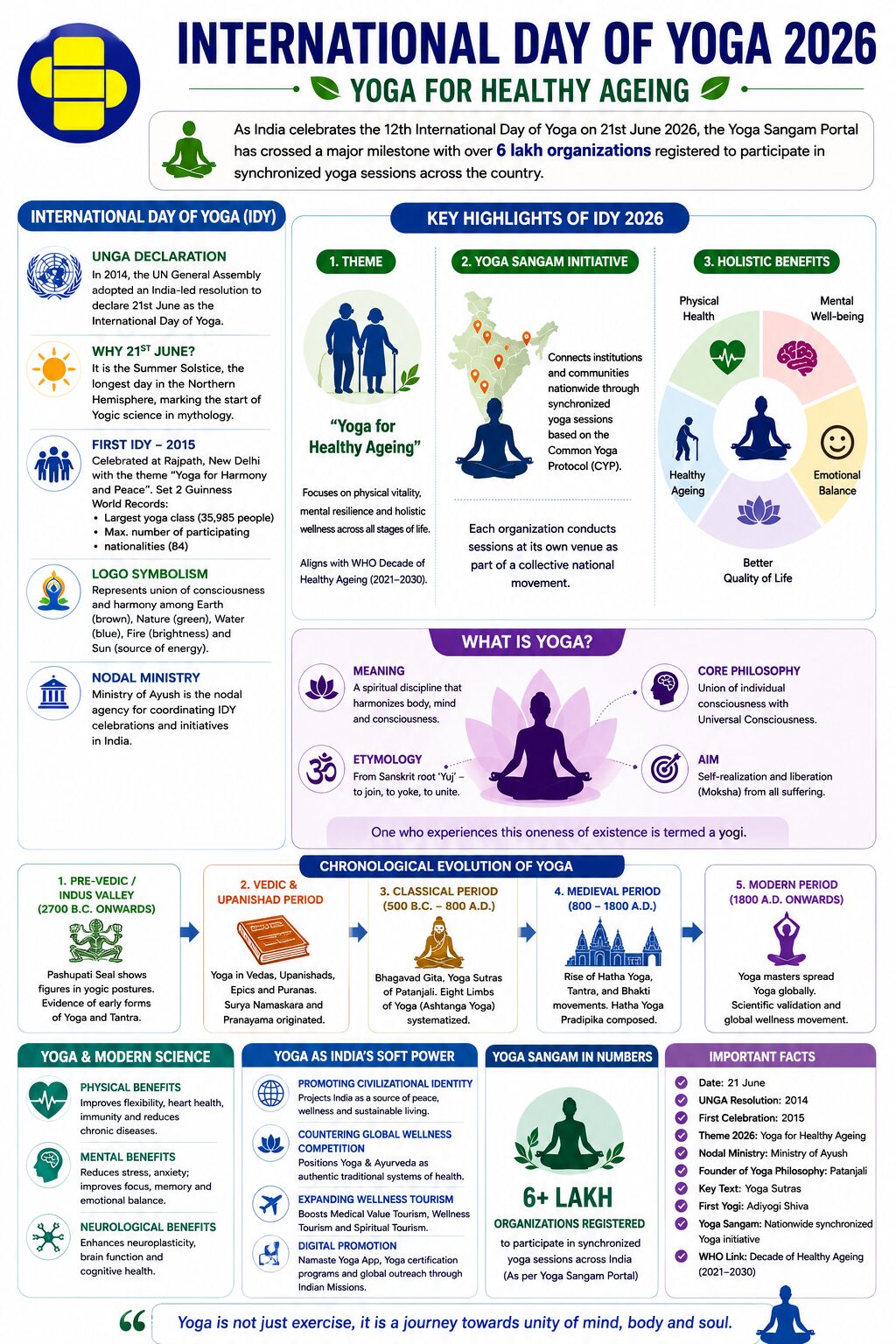
Evolution of Yoga Through History
Pre-Vedic and Indus Valley Period
Evidence of yogic practices can be traced to the Indus Valley Civilization.
The famous Pashupati Seal depicts a figure seated in a meditative posture resembling Yogic asanas.
Vedic and Upanishadic Period
Yoga evolved through:
- Vedas
- Upanishads
- Epics
- Puranas
Practices such as:
- Meditation
- Pranayama
- Sun worship
became integral parts of spiritual life.
Classical Period
This period witnessed the systematic development of Yoga.
Major contributions came from:
- Patanjali
- Mahavira
- Buddha
The Bhagavad Gita elaborated:
- Karma Yoga
- Bhakti Yoga
- Jnana Yoga
Patanjali’s Eight Limbs of Yoga
- Yama
- Niyama
- Asana
- Pranayama
- Pratyahara
- Dharana
- Dhyana
- Samadhi
Medieval Period
The rise of:
- Hatha Yoga
- Tantra traditions
- Bhakti movements
contributed significantly to Yoga’s development.
The Hatha Yoga Pradipika by Swatmarama became one of the foundational texts of Hatha Yoga.
Modern Period
Prominent Yoga masters who popularized Yoga globally include:
- Swami Vivekananda
- Ramana Maharshi
- Paramhansa Yogananda
- Tirumalai Krishnamacharya
- B.K.S. Iyengar
- Pattabhi Jois
Today, Yoga has evolved into a global wellness movement supported by scientific research.
Yoga and Modern Science
Modern medical studies increasingly validate Yoga’s benefits.
Physical Benefits
- Improved flexibility
- Better cardiovascular health
- Enhanced immunity
- Reduced risk of chronic diseases
Mental Benefits
- Reduced anxiety
- Improved concentration
- Stress management
- Emotional balance
Neurological Benefits
Research indicates Yoga positively influences:
- Neuroplasticity
- Brain function
- Cognitive health
Yoga as India’s Soft Power Tool
Yoga has become one of India’s most successful instruments of cultural diplomacy.
Promoting India’s Civilizational Identity
Yoga projects India as a source of:
- Peace
- Wellness
- Sustainable living
- Spiritual knowledge
It strengthens India’s image as a Vishwabandhu (Friend of the World).
Countering Global Wellness Competition
India is positioning Yoga and Ayurveda as global alternatives in the traditional medicine sector.
Key initiatives include:
- WHO Global Centre for Traditional Medicine (Jamnagar)
- Global Ayurveda collaborations
- International Yoga outreach programmes
Expanding Wellness Tourism
India is leveraging Yoga to promote:
- Medical Value Tourism
- Wellness Tourism
- Spiritual Tourism
Major destinations include:
- Rishikesh
- Varanasi
- Kerala
- Mysuru
Digital Promotion of Yoga
India has expanded Yoga’s global reach through:
Namaste Yoga App
Provides authentic Yoga learning resources globally.
Yoga Certification Programs
Conducted through:
- Indian Missions Abroad
- Ministry of Ayush
- Yoga Certification Board
These initiatives ensure quality control and preserve the authenticity of Yoga traditions.
Challenges Before Global Yoga Movement
Despite its popularity, challenges remain:
- Commercialization of Yoga
- Dilution of traditional teachings
- Cultural appropriation
- Lack of standardized training
India continues efforts to preserve Yoga’s philosophical roots while encouraging global adoption.
International Day of Yoga 2026 Facts for UPSC & State PCS
| Topic | Fact |
| International Day of Yoga | 21 June |
| UNGA Resolution | 2014 |
| First Celebration | 2015 |
| Theme 2026 | Yoga for Healthy Ageing |
| Nodal Ministry | Ministry of Ayush |
| Founder of Yoga Philosophy | Patanjali |
| Key Text | Yoga Sutras |
| First Yogi | Adiyogi Shiva |
| Yoga Sangam | Nationwide synchronized Yoga initiative |
| WHO Link | Decade of Healthy Ageing (2021–2030) |
Conclusion
From its origins in ancient Indian civilization to its recognition by the United Nations, Yoga has emerged as one of humanity’s most powerful tools for holistic well-being. Beyond physical exercise, Yoga represents a philosophy of balance, harmony, and self-realization. Through initiatives such as International Day of Yoga, wellness tourism, digital outreach, and Yoga diplomacy, India is transforming its civilizational heritage into a global public good while strengthening its role as a compassionate and responsible global leader.
UPSC Mains Question
“Yoga has evolved from a spiritual discipline to an instrument of India’s soft power diplomacy.” Examine the significance of Yoga in promoting India’s global cultural influence and public diplomacy. (250 Words)
Attempt Today’s Current Affairs Quiz
