

Global Terrorism Index 2026
The 13th edition of the Global Terrorism Index (GTI) 2026 reported a significant decline in global terrorism during 2025. Deaths caused by terrorism fell by 28%, while the number of terrorist incidents declined by 22%. However, the decline does not necessarily indicate a safer world. Terrorism has become increasingly concentrated in conflict-affected regions, decentralised in organisation, and technology-driven in operation. According to the index, Pakistan emerged as the country most affected by terrorism, while India ranked 13th globally.
What is the Global Terrorism Index?
The Global Terrorism Index (GTI) is an annual report published by the Institute for Economics & Peace (IEP), an independent international think tank headquartered in Sydney, Australia. The index provides a comprehensive assessment of the impact of terrorism across countries. It broadly examines factors such as:
- Terrorism-related deaths
- Number of terrorist incidents
- Injuries caused by terrorist attacks
- Hostages and wider impact of terrorism
The GTI also analyses long-term trends, geographical hotspots, terrorist organisations, conflict dynamics, and emerging security threats.
Key Findings of Global Terrorism Index 2026
1. Global Terrorism Declined in 2025
The report recorded an overall improvement in global terrorism indicators.
- Terrorism-related deaths declined by 28%.
- Terrorist incidents declined by 22%.
However, terrorism remains highly concentrated in fragile and conflict-affected countries.
2. Terrorism is Highly Concentrated Geographically
Nearly 70% of global terrorism-related deaths occurred in just five countries:
- Pakistan
- Burkina Faso
- Nigeria
- Niger
- Democratic Republic of the Congo (DRC)
The Sahel region of Sub-Saharan Africa alone accounted for more than half of global terrorism fatalities.
3. Conflict is the Biggest Driver
Around 99% of terrorism-related deaths occur in countries affected by armed conflict or political instability.
This highlights the close relationship between:
Armed Conflict → Weak Governance → Security Vacuum → Extremist Expansion → Terrorism
4. Border Regions are Major Terror Hotspots
More than 60% of terrorist attacks occur within 100 km of an international border.
Border regions can facilitate:
- Cross-border infiltration
- Arms trafficking
- Drug smuggling
- Terror financing
- Movement of extremist groups
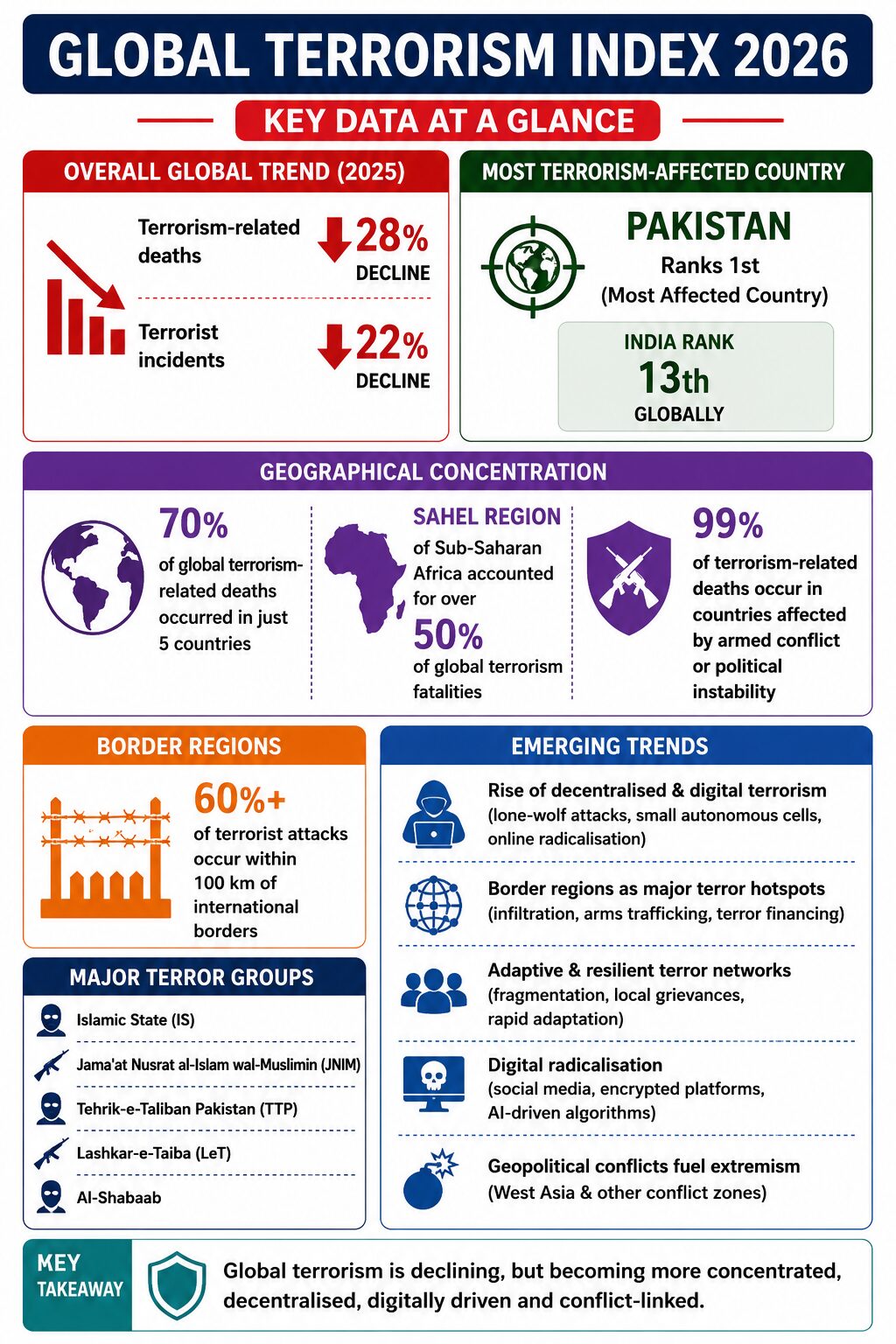
Emerging Trends in Global Terrorism
Modern terrorism is becoming increasingly difficult to detect through conventional security systems.
Decentralised Terrorism
Large hierarchical organisations are increasingly being supplemented by:
- Lone-wolf attackers
- Small autonomous cells
- Local affiliates
- Self-radicalised individuals
In Western countries, 93% of fatal terrorist attacks over the previous five years were reportedly carried out by lone actors.
Digital Radicalisation
Terrorist networks increasingly exploit:
- Social media
- Encrypted communication
- Artificial Intelligence
- Cryptocurrencies
- Dark web platforms
Digital platforms can facilitate propaganda, recruitment, financing, radicalisation, and operational coordination without direct physical contact.
Major Terrorist Organisations
The global terrorism landscape remains concentrated around several major extremist networks and their affiliates.
Prominent groups highlighted in the terrorism landscape include:
- Islamic State (IS)
- Jama’at Nusrat al-Islam wal-Muslimin (JNIM)
- Tehrik-e-Taliban Pakistan (TTP)
- Lashkar-e-Taiba (LeT)
- Al-Shabaab
Many such organisations increasingly operate through decentralised regional affiliates rather than a single centralised structure.
India in Global Terrorism Index 2026
India was ranked 13th among countries affected by terrorism.
India faces a diverse set of terrorism-related security challenges, including:
- Cross-border terrorism
- Proxy warfare
- Radicalisation and lone-wolf threats
- Cyber-enabled terrorism
- Terror financing
- Organised crime-terror networks
- Maritime infiltration
India has adopted a zero-tolerance and intelligence-led counter-terrorism approach.
Major elements include stronger laws such as the UAPA, an expanded role for the National Investigation Agency (NIA), intelligence sharing through the Multi-Agency Centre (MAC), and international cooperation against terror financing.
India has also consistently advocated the adoption of a Comprehensive Convention on International Terrorism (CCIT) at the United Nations.
Why Declining Terrorism Numbers Can Be Misleading
A fall in global deaths does not mean that the terrorism threat has disappeared.
Three structural changes remain particularly important:
- Geographical concentration: Terrorism is increasingly concentrated in fragile states, especially in the Sahel and conflict zones.
- Technological adaptation: Extremist networks are using digital platforms and emerging technologies more effectively.
- Network fragmentation: Smaller autonomous cells are harder for intelligence agencies to detect than conventional hierarchical organisations.
Therefore, counter-terrorism increasingly requires a combination of security operations, intelligence cooperation, border management, cyber surveillance, terror-financing controls, and improved governance.
Important Facts for Exams
- Report: Global Terrorism Index 2026
- Edition: 13th
- Published by: Institute for Economics & Peace (IEP)
- IEP Headquarters: Sydney, Australia
- Global terrorism deaths declined by 28% in 2025.
- Terrorist incidents declined by 22%.
- Pakistan: Most terrorism-affected country in GTI 2026.
- India: Ranked 13th.
- Nearly 70% of terrorism deaths were concentrated in five countries.
- The Sahel region accounted for over half of global terrorism fatalities.
- Around 99% of terrorism deaths occur in conflict-affected or politically unstable countries.
- Over 60% of terrorist attacks occur within 100 km of international borders.
- CCIT: Comprehensive Convention on International Terrorism, proposed by India at the UN in 1996.
- FATF: Global body combating money laundering and terrorist financing.
- UAPA, 1967: India’s key anti-terror legislation.
- NIA: India’s specialised federal counter-terror investigation agency.
