Karl Marx (1818–1883) is one of the most influential thinkers in the history of social sciences. His writings transformed political thought, economics, and sociology, laying the intellectual foundations of Conflict Theory, Historical Materialism, Class Struggle, and Capitalist Critique.
Marx is not only a political philosopher but also a foundational sociologist, whose ideas continue to shape academic debates, policy discussions, and global social movements.
From understanding exploitation in capitalism to analyzing power relations in society, Marx’s theories remain central for UPSC Sociology Optional, UGC-NET, and all social science disciplines.
Early Life and Intellectual Background
Karl Marx was born in Trier, Germany, in 1818. He studied law, philosophy, and history before immersing himself in political economy and revolutionary activism.
Important Influences on Marx:
- Hegel’s dialectics → inspired Marx’s dialectical method.
- British political economists (Adam Smith, David Ricardo) → shaped his critique of capitalism.
- French socialist thinkers → influenced his ideas on class struggle and revolution.
- Industrial Revolution in Europe → exposed Marx to exploitation, factory labour, and inequality.
These influences helped Marx develop a materialist and revolutionary framework to study human society.
Key Concepts and Theories of Karl Marx
1. Historical Materialism
Historical Materialism is Marx’s central theory explaining how human societies evolve.
It argues that material conditions—especially economic production—shape all aspects of society.
Core Ideas:
- The economic base (forces + relations of production) determines the superstructure (law, politics, culture, religion).
- History progresses through contradictions between productive forces and existing relations.
- Social change occurs through class conflict.
Stages of Development:
- Primitive Communism
- Slave Society
- Feudalism
- Capitalism
- Socialism
- Communism (future classless society)
Marx sees history as a scientific process driven by economic forces, not divine will or abstract ideas.
2. Dialectical Materialism
Marx adopted Hegel’s dialectics (thesis → antithesis → synthesis) but replaced “ideas” with material conditions.
Key Points of Dialectic Materialism:
- Material reality is primary; ideas are secondary.
- Society changes due to contradictions within the economic system.
- These contradictions lead to revolution, producing a new social order.
Dialectical Materialism lays the philosophical base for Marxism.
3. Class and Class Struggle
Marx saw class conflict as the driving force of history.
Classes Under Capitalism:
- Bourgeoisie → owners of means of production
- Proletariat → workers who sell their labour
Why Conflict Occurs:
- Owners maximize profit; workers seek fair wages.
- This contradiction leads to class struggle, revolution, and social transformation.
“History of all hitherto existing society is the history of class struggle.” — Marx
4. Alienation
Marx described alienation as the worker’s sense of powerlessness in capitalist society.
Forms of Alienation:
- From the product of labour
- From the production process
- From their own human potential
- From fellow workers
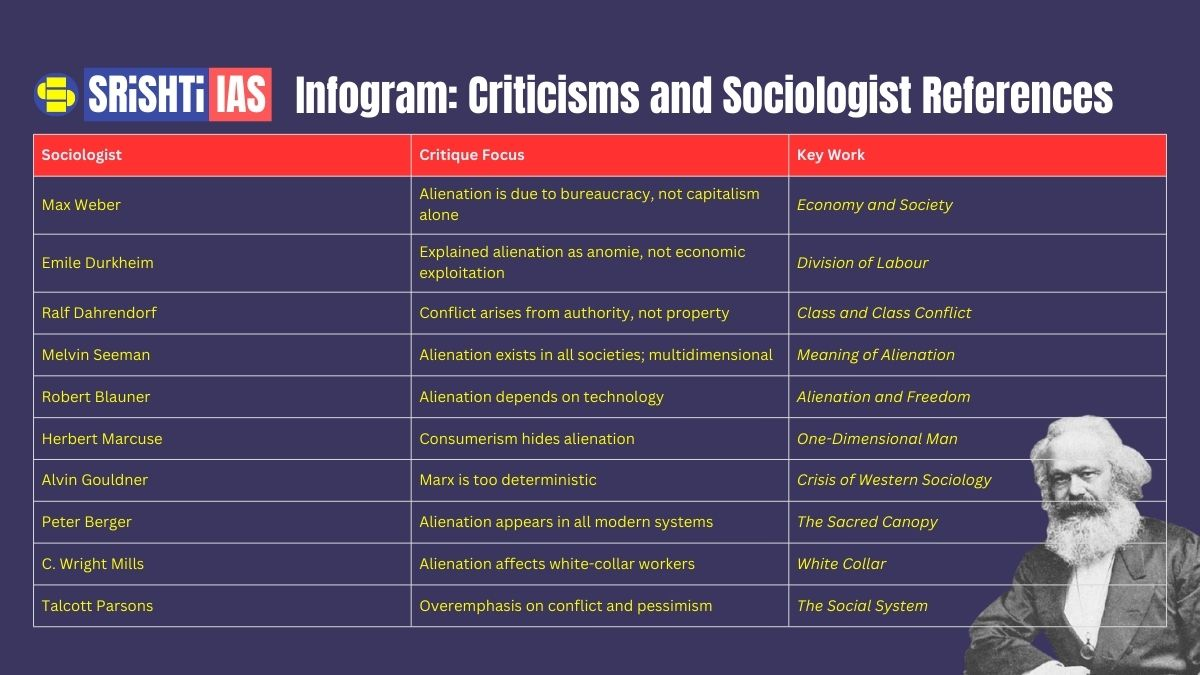
Alienation happens because workers do not control production; capitalists do. Although the theory of alienation has been criticised by many Sociological thinkers, it remains relevant to contemporary society.
5. Labour Theory of Value and Surplus Value
Marx argued that capitalists earn profits by extracting surplus value from workers.
How Surplus Value is Created:
- Workers create more value than the wages they receive.
- The difference (surplus) is appropriated by employers.
This results in:
- Exploitation
- Wage slavery
- Concentration of wealth
This concept forms the core of Marx’s critique of capitalism.
6. Theory of Capitalism
Marx saw capitalism as a dynamic but unstable system.
Features of Capitalism According to Marx:
- Private ownership of production
- Profit-driven competition
- Exploitation of labour
- Commodity fetishism
- Periodic economic crises
- Polarization of classes
Though productive, capitalism is inherently contradictory and will inevitably collapse.
7. Revolution and Communism
Marx believed the working class would eventually develop class consciousness and overthrow capitalism.
Stages After Revolution:
- Dictatorship of the proletariat
- Abolition of private property
- Establishment of socialism
- Emergence of a classless, stateless society — communism
He saw communism as the most just and equitable system.
Karl Marx’s Major Works
- The Communist Manifesto (1848) – with Friedrich Engels
- Das Kapital Volume I (1867)
- The German Ideology (1846)
- Economic and Philosophic Manuscripts of 1844
- Critique of the Gotha Programme
These works shaped modern sociology, economics, political science, and revolutionary movements.
Marx’s Contribution to Sociology
Marx is considered one of the founding fathers of sociology. His theories form the basis of:
1. Conflict Theory
Society is marked by inequality, competition, and struggle for resources.
2. Study of Social Change
Marx emphasized revolutionary transformations driven by economic forces.
3. Analysis of Capitalist Society
He explained how:
- labour is commodified
- profit originates in exploitation
- class inequality deepens under capitalism
4. Role of Economy in Social Life
Marx highlighted the importance of the economic base in shaping culture, politics, and ideology.
5. Study of Power and Inequality
Marx’s work is foundational for:
- feminist theory
- postcolonial theory
- labour studies
- class studies
Criticism of Karl Marx
Although influential, Marx’s theories face several criticisms:
1. Economic Determinism
Critics argue Marx overemphasizes economy and ignores culture, religion, and identity.
2. Failure of Communist States
Soviet Union and East Europe collapsed, challenging the inevitability of communism.
3. Underestimation of Middle Class
Capitalism did not collapse, and the middle class expanded instead of disappearing.
4. Overemphasis on Revolution
Modern societies have adopted reforms instead of violent revolutions.
Despite criticisms, Marx’s analytical framework remains powerful and relevant.
Relevance of Karl Marx in Modern Times
Marx’s ideas continue to explain modern problems:
1. Rising Inequality
Global wealth concentration validates Marx’s concerns.
2. Labour Exploitation
Contract work, gig economy, and job insecurity reflect alienation and surplus value extraction.
3. Corporate Power and Monopolies
Tech giants (Google, Amazon) resemble Marx’s prediction of capitalist concentration.
4. Social Movements
Workers’ rights, anti-globalization, and left-wing politics draw inspiration from Marxism.
5. Critique of Consumerism
“Commodity Fetishism” explains modern consumer culture.
Marx remains one of the most relevant thinkers of the 21st century.
Conclusion
Karl Marx reshaped the intellectual landscape of modern social sciences. His theories of historical materialism, class struggle, alienation, surplus value, and capitalism continue to guide sociological inquiry.
Despite criticisms, Marx’s ideas remain deeply relevant in analyzing inequality, labour exploitation, corporate power, and global capitalism.
For UPSC and NET-JRF aspirants, understanding Marx is essential, as his theories form the core of sociological thinking and appear in numerous exam questions.
FAQs
Karl Marx (1818–1883) was a German philosopher, economist, and social theorist whose ideas laid the foundation of modern sociology, especially the conflict perspective. His theories of Historical Materialism, Class Struggle, Alienation, and Surplus Value reshaped the study of society. He is recognized as one of the three founding fathers of sociology, along with Emile Durkheim and Max Weber.
Historical Materialism is Marx’s theory of social development, which argues that the material/economic structure of society determines its politics, culture, law, and ideology. According to Marx, human history progresses through stages such as primitive communism, slavery, feudalism, capitalism, socialism, and communism, driven by contradictions between productive forces and relations of production.
Class struggle refers to the conflict between different social classes that arises due to unequal control over resources and means of production. In capitalist society, this struggle occurs between the bourgeoisie (owners) and the proletariat (workers). Marx believed this conflict is the driving force of social change and will eventually lead to the overthrow of capitalism.
Alienation is the condition where workers feel disconnected from their work, their products, their own human potential, and from other people. This happens in capitalist systems because workers do not control production; instead, they work for wages while the capitalist controls profit and decision-making. Alienation reduces human creativity and leads to exploitation and dissatisfaction.
Karl Marx remains highly relevant today as his ideas help analyze inequality, labour exploitation, capitalist crises, corporate dominance, and consumerism. Concepts like surplus value, alienation, and commodity fetishism explain modern issues such as gig economy exploitation, wealth concentration, job insecurity, and global economic inequalities. Many social movements worldwide—especially labour rights, anti-globalization, and left-wing politics—continue to draw inspiration from Marx.
Share this Article with your friends :
Discover more from Srishti IAS
Subscribe to get the latest posts sent to your email.